Close


As iron sharpens iron, one man sharpens another. (Proverbs 27:17)
In this session, you will explore an overview of how Jesus developed a movement of disciple-making by using multiplying leaders to carry his kingdom vision for all nations.


23 Above all else, guard your heart,
for everything you do flows from it.
“Blessed are the pure in heart for they shall see God” (Matthew 5:8).
8 Blessed are the pure in heart,
for they will see God.
“Do not store up for yourselves treasures on earth, where moth and rust destroy, and where thieves break in and steal. But store up for yourselves treasures in heaven, where moth and rust do not destroy, and where thieves do not break in and steal. For where your treasure is there your heart will be also.” (Matthew 6:19-21)
19 ‘Do not store up for yourselves treasures on earth, where moths and vermin destroy, and where thieves break in and steal.20 But store up for yourselves treasures in heaven, where moths and vermin do not destroy, and where thieves do not break in and steal.21 For where your treasure is, there your heart will be also.
“…the seed on good soil stands for those with a noble and good heart, who hear the word, retain it, and by persevering produce a crop.” (Luke 8:15)
15 But the seed on good soil stands for those with a noble and good heart, who hear the word, retain it, and by persevering produce a crop.

Jesus is our model for life and ministry. Because He is our model, it is important to know His character, His priorities, and His process for building a disciple-making movement. This movement multiplies others for fulfilling the Great Commission.
1 In the beginning was the Word, and the Word was with God, and the Word was God.
14 The Word became flesh and made his dwelling among us. We have seen his glory, the glory of the one and only Son, who came from the Father, full of grace and truth.
Though fully God, He chose to live His life as fully man, in total surrendered obedience to His heavenly Father. What He achieved in His life and ministry, He achieved as the man from Nazareth, the Son of Man, through the power and presence of the Holy Spirit in fulfilment of the Father’s will. Though He had every right to operate out of his divinity, He chose to only live out of His perfect sinless humanity to be our example of how to fully glorify God in our life and ministry.
17 For this reason he had to be made like them, fully human in every way, in order that he might become a merciful and faithful high priest in service to God, and that he might make atonement for the sins of the people.
1 Therefore, holy brothers and sisters, who share in the heavenly calling, fix your thoughts on Jesus, whom we acknowledge as our apostle and high priest.
The four Gospel writers record a summary of His life and teachings. By studying their written witness, we can learn about the development of His movement. In His humanity, even Jesus was subject to time and space and lived in the sequence of hours, days, weeks, years. He initiated and developed His movement in time. Therefore, Jesus case study is very instructive for leaders. We gain insight into how His life and movement unfolded over time by reconstructing a chronological sequence from the evidence provided by the Gospels.
Luke tells us that he sought to provide a well investigated and “orderly account” of Jesus life (Luke 1:1-4).
1 Many have undertaken to draw up an account of the things that have been fulfilled among us,2 just as they were handed down to us by those who from the first were eye witnesses and servants of the word.3 With this in mind, since I myself have carefully investigated everything from the beginning, I too decided to write an orderly account for you, most excellent Theophilus,4 so that you may know the certainty of the things you have been taught.
1 In the beginning was the Word, and the Word was with God, and the Word was God.2 He was with God in the beginning.3 Through him all things were made; without him nothing was made that has been made.4 In him was life, and that life was the light of all mankind.5 The light shines in the darkness, and the darkness has not overcome it.
6 There was a man sent from God whose name was John.7 He came as a witness to testify concerning that light, so that through him all might believe.8 He himself was not the light; he came only as a witness to the light.
9 The true light that gives light to everyone was coming into the world.10 He was in the world, and though the world was made through him, the world did not recognise him.11 He came to that which was his own, but his own did not receive him.12 Yet to all who did receive him, to those who believed in his name, he gave the right to become children of God –13 children born not of natural descent, nor of human decision or a husband’s will, but born of God.
14 The Word became flesh and made his dwelling among us. We have seen his glory, the glory of the one and only Son, who came from the Father, full of grace and truth.
15 (John testified concerning him. He cried out, saying, ‘This is the one I spoke about when I said, “He who comes after me has surpassed me because he was before me.”’)16 Out of his fullness we have all received grace in place of grace already given.17 For the law was given through Moses; grace and truth came through Jesus Christ.18 No one has ever seen God, but the one and only Son, who is himself God and is in the closest relationship with the Father, has made him known.
19 Now this was John’s testimony when the Jewish leaders in Jerusalem sent priests and Levites to ask him who he was.20 He did not fail to confess, but confessed freely, ‘I am not the Messiah.’
21 They asked him, ‘Then who are you? Are you Elijah?’
He said, ‘I am not.’
‘Are you the Prophet?’
He answered, ‘No.’
22 Finally they said, ‘Who are you? Give us an answer to take back to those who sent us. What do you say about yourself?’
23 John replied in the words of Isaiah the prophet, ‘I am the voice of one calling in the wilderness, “Make straight the way for the Lord.”’
24 Now the Pharisees who had been sent25 questioned him, ‘Why then do you baptise if you are not the Messiah, nor Elijah, nor the Prophet?’
26 ‘I baptise with water,’ John replied, ‘but among you stands one you do not know.27 He is the one who comes after me, the straps of whose sandals I am not worthy to untie.’
28 This all happened at Bethany on the other side of the Jordan, where John was baptising.
29 The next day John saw Jesus coming towards him and said, ‘Look, the Lamb of God, who takes away the sin of the world!30 This is the one I meant when I said, “A man who comes after me has surpassed me because he was before me.”31 I myself did not know him, but the reason I came baptising with water was that he might be revealed to Israel.’
32 Then John gave this testimony: ‘I saw the Spirit come down from heaven as a dove and remain on him.33 And I myself did not know him, but the one who sent me to baptise with water told me, “The man on whom you see the Spirit come down and remain is the one who will baptise with the Holy Spirit.”34 I have seen and I testify that this is God’s Chosen One.’
35 The next day John was there again with two of his disciples.36 When he saw Jesus passing by, he said, ‘Look, the Lamb of God!’
37 When the two disciples heard him say this, they followed Jesus.38 Turning round, Jesus saw them following and asked, ‘What do you want?’
They said, ‘Rabbi’ (which means ‘Teacher’), ‘where are you staying?’
39 ‘Come,’ he replied, ‘and you will see.’
So they went and saw where he was staying, and they spent that day with him. It was about four in the afternoon.
40 Andrew, Simon Peter’s brother, was one of the two who heard what John had said and who had followed Jesus.41 The first thing Andrew did was to find his brother Simon and tell him, ‘We have found the Messiah’ (that is, the Christ).42 And he brought him to Jesus.
Jesus looked at him and said, ‘You are Simon son of John. You will be called Cephas’ (which, when translated, is Peter).
43 The next day Jesus decided to leave for Galilee. Finding Philip, he said to him, ‘Follow me.’
44 Philip, like Andrew and Peter, was from the town of Bethsaida.45 Philip found Nathanael and told him, ‘We have found the one Moses wrote about in the Law, and about whom the prophets also wrote – Jesus of Nazareth, the son of Joseph.’
46 ‘Nazareth! Can anything good come from there?’ Nathanael asked.
‘Come and see,’ said Philip.
47 When Jesus saw Nathanael approaching, he said of him, ‘Here truly is an Israelite in whom there is no deceit.’
48 ‘How do you know me?’ Nathanael asked.
Jesus answered, ‘I saw you while you were still under the fig-tree before Philip called you.’
49 Then Nathanael declared, ‘Rabbi, you are the Son of God; you are the king of Israel.’
50 Jesus said, ‘You believe because I told you I saw you under the fig-tree. You will see greater things than that.’51 He then added, ‘Very truly I tell you, you will see “heaven open, and the angels of God ascending and descending on” the Son of Man.’
1 On the third day a wedding took place at Cana in Galilee. Jesus’ mother was there,2 and Jesus and his disciples had also been invited to the wedding.3 When the wine was gone, Jesus’ mother said to him, ‘They have no more wine.’
4 ‘Woman, why do you involve me?’ Jesus replied. ‘My hour has not yet come.’
5 His mother said to the servants, ‘Do whatever he tells you.’
6 Nearby stood six stone water jars, the kind used by the Jews for ceremonial washing, each holding from eighty to a hundred and twenty litres.
7 Jesus said to the servants, ‘Fill the jars with water’; so they filled them to the brim.
8 Then he told them, ‘Now draw some out and take it to the master of the banquet.’
They did so,9 and the master of the banquet tasted the water that had been turned into wine. He did not realise where it had come from, though the servants who had drawn the water knew. Then he called the bridegroom aside10 and said, ‘Everyone brings out the choice wine first and then the cheaper wine after the guests have had too much to drink; but you have saved the best till now.’
11 What Jesus did here in Cana of Galilee was the first of the signs through which he revealed his glory; and his disciples believed in him.
12 After this he went down to Capernaum with his mother and brothers and his disciples. There they stayed for a few days.
13 When it was almost time for the Jewish Passover, Jesus went up to Jerusalem.14 In the temple courts he found people selling cattle, sheep and doves, and others sitting at tables exchanging money.15 So he made a whip out of cords, and drove all from the temple courts, both sheep and cattle; he scattered the coins of the money-changers and overturned their tables.16 To those who sold doves he said, ‘Get these out of here! Stop turning my Father’s house into a market!’17 His disciples remembered that it is written: ‘Zeal for your house will consume me.’
18 The Jews then responded to him, ‘What sign can you show us to prove your authority to do all this?’
19 Jesus answered them, ‘Destroy this temple, and I will raise it again in three days.’
20 They replied, ‘It has taken forty-six years to build this temple, and you are going to raise it in three days?’21 But the temple he had spoken of was his body.22 After he was raised from the dead, his disciples recalled what he had said. Then they believed the Scripture and the words that Jesus had spoken.
23 Now while he was in Jerusalem at the Passover Festival, many people saw the signs he was performing and believed in his name.24 But Jesus would not entrust himself to them, for he knew all people.25 He did not need any testimony about mankind, for he knew what was in each person.
1 Now there was a Pharisee, a man named Nicodemus who was a member of the Jewish ruling council.2 He came to Jesus at night and said, ‘Rabbi, we know that you are a teacher who has come from God. For no one could perform the signs you are doing if God were not with him.’
3 Jesus replied, ‘Very truly I tell you, no one can see the kingdom of God unless they are born again.’
4 ‘How can someone be born when they are old?’ Nicodemus asked. ‘Surely they cannot enter a second time into their mother’s womb to be born!’
5 Jesus answered, ‘Very truly I tell you, no one can enter the kingdom of God unless they are born of water and the Spirit.6 Flesh gives birth to flesh, but the Spirit gives birth to spirit.7 You should not be surprised at my saying, “You must be born again.”8 The wind blows wherever it pleases. You hear its sound, but you cannot tell where it comes from or where it is going. So it is with everyone born of the Spirit.’
9 ‘How can this be?’ Nicodemus asked.
10 ‘You are Israel’s teacher,’ said Jesus, ‘and do you not understand these things?11 Very truly I tell you, we speak of what we know, and we testify to what we have seen, but still you people do not accept our testimony.12 I have spoken to you of earthly things and you do not believe; how then will you believe if I speak of heavenly things?13 No one has ever gone into heaven except the one who came from heaven – the Son of Man.14 Just as Moses lifted up the snake in the wilderness, so the Son of Man must be lifted up,15 that everyone who believes may have eternal life in him.’
16 For God so loved the world that he gave his one and only Son, that whoever believes in him shall not perish but have eternal life.17 For God did not send his Son into the world to condemn the world, but to save the world through him.18 Whoever believes in him is not condemned, but whoever does not believe stands condemned already because they have not believed in the name of God’s one and only Son.19 This is the verdict: light has come into the world, but people loved darkness instead of light because their deeds were evil.20 Everyone who does evil hates the light, and will not come into the light for fear that their deeds will be exposed.21 But whoever lives by the truth comes into the light, so that it may be seen plainly that what they have done has been done in the sight of God.
22 After this, Jesus and his disciples went out into the Judean countryside, where he spent some time with them, and baptised.23 Now John also was baptising at Aenon near Salim, because there was plenty of water, and people were coming and being baptised.24 (This was before John was put in prison.)25 An argument developed between some of John’s disciples and a certain Jew over the matter of ceremonial washing.26 They came to John and said to him, ‘Rabbi, that man who was with you on the other side of the Jordan – the one you testified about – look, he is baptising, and everyone is going to him.’
27 To this John replied, ‘A person can receive only what is given them from heaven.28 You yourselves can testify that I said, “I am not the Messiah but am sent ahead of him.”29 The bride belongs to the bridegroom. The friend who attends the bridegroom waits and listens for him, and is full of joy when he hears the bridegroom’s voice. That joy is mine, and it is now complete.30 He must become greater; I must become less.’
31 The one who comes from above is above all; the one who is from the earth belongs to the earth, and speaks as one from the earth. The one who comes from heaven is above all.32 He testifies to what he has seen and heard, but no one accepts his testimony.33 Whoever has accepted it has certified that God is truthful.34 For the one whom God has sent speaks the words of God, for God gives the Spirit without limit.35 The Father loves the Son and has placed everything in his hands.36 Whoever believes in the Son has eternal life, but whoever rejects the Son will not see life, for God’s wrath remains on them.
1 Now Jesus learned that the Pharisees had heard that he was gaining and baptising more disciples than John –2 although in fact it was not Jesus who baptised, but his disciples.3 So he left Judea and went back once more to Galilee.
4 Now he had to go through Samaria.5 So he came to a town in Samaria called Sychar, near the plot of ground Jacob had given to his son Joseph.6 Jacob’s well was there, and Jesus, tired as he was from the journey, sat down by the well. It was about noon.
7 When a Samaritan woman came to draw water, Jesus said to her, ‘Will you give me a drink?’8 (His disciples had gone into the town to buy food.)
9 The Samaritan woman said to him, ‘You are a Jew and I am a Samaritan woman. How can you ask me for a drink?’ (For Jews do not associate with Samaritans.)
10 Jesus answered her, ‘If you knew the gift of God and who it is that asks you for a drink, you would have asked him and he would have given you living water.’
11 ‘Sir,’ the woman said, ‘you have nothing to draw with and the well is deep. Where can you get this living water?12 Are you greater than our father Jacob, who gave us the well and drank from it himself, as did also his sons and his livestock?’
13 Jesus answered, ‘Everyone who drinks this water will be thirsty again,14 but whoever drinks the water I give them will never thirst. Indeed, the water I give them will become in them a spring of water welling up to eternal life.’
15 The woman said to him, ‘Sir, give me this water so that I won’t get thirsty and have to keep coming here to draw water.’
16 He told her, ‘Go, call your husband and come back.’
17 ‘I have no husband,’ she replied.
Jesus said to her, ‘You are right when you say you have no husband.18 The fact is, you have had five husbands, and the man you now have is not your husband. What you have just said is quite true.’
19 ‘Sir,’ the woman said, ‘I can see that you are a prophet.20 Our ancestors worshipped on this mountain, but you Jews claim that the place where we must worship is in Jerusalem.’
21 ‘Woman,’ Jesus replied, ‘believe me, a time is coming when you will worship the Father neither on this mountain nor in Jerusalem.22 You Samaritans worship what you do not know; we worship what we do know, for salvation is from the Jews.23 Yet a time is coming and has now come when the true worshippers will worship the Father in the Spirit and in truth, for they are the kind of worshippers the Father seeks.24 God is spirit, and his worshippers must worship in the Spirit and in truth.’
25 The woman said, ‘I know that Messiah’ (called Christ) ‘is coming. When he comes, he will explain everything to us.’
26 Then Jesus declared, ‘I, the one speaking to you – I am he.’
27 Just then his disciples returned and were surprised to find him talking with a woman. But no one asked, ‘What do you want?’ or ‘Why are you talking with her?’
28 Then, leaving her water jar, the woman went back to the town and said to the people,29 ‘Come, see a man who told me everything I’ve ever done. Could this be the Messiah?’30 They came out of the town and made their way towards him.
31 Meanwhile his disciples urged him, ‘Rabbi, eat something.’
32 But he said to them, ‘I have food to eat that you know nothing about.’
33 Then his disciples said to each other, ‘Could someone have brought him food?’
34 ‘My food,’ said Jesus, ‘is to do the will of him who sent me and to finish his work.35 Don’t you have a saying, “It’s still four months until harvest”? I tell you, open your eyes and look at the fields! They are ripe for harvest.36 Even now the one who reaps draws a wage and harvests a crop for eternal life, so that the sower and the reaper may be glad together.37 Thus the saying “One sows and another reaps” is true.38 I sent you to reap what you have not worked for. Others have done the hard work, and you have reaped the benefits of their labour.’
39 Many of the Samaritans from that town believed in him because of the woman’s testimony, ‘He told me everything I’ve ever done.’40 So when the Samaritans came to him, they urged him to stay with them, and he stayed two days.41 And because of his words many more became believers.
42 They said to the woman, ‘We no longer believe just because of what you said; now we have heard for ourselves, and we know that this man really is the Saviour of the world.’
43 After the two days he left for Galilee.44 (Now Jesus himself had pointed out that a prophet has no honour in his own country.)45 When he arrived in Galilee, the Galileans welcomed him. They had seen all that he had done in Jerusalem at the Passover Festival, for they also had been there.
46 Once more he visited Cana in Galilee, where he had turned the water into wine. And there was a certain royal official whose son lay ill at Capernaum.47 When this man heard that Jesus had arrived in Galilee from Judea, he went to him and begged him to come and heal his son, who was close to death.
48 ‘Unless you people see signs and wonders,’ Jesus told him, ‘you will never believe.’
49 The royal official said, ‘Sir, come down before my child dies.’
50 ‘Go,’ Jesus replied, ‘your son will live.’
The man took Jesus at his word and departed.51 While he was still on the way, his servants met him with the news that his boy was living.52 When he enquired as to the time when his son got better, they said to him, ‘Yesterday, at one in the afternoon, the fever left him.’
53 Then the father realised that this was the exact time at which Jesus had said to him, ‘Your son will live.’ So he and his whole household believed.
54 This was the second sign Jesus performed after coming from Judea to Galilee.
1 Six days before the Passover, Jesus came to Bethany, where Lazarus lived, whom Jesus had raised from the dead.2 Here a dinner was given in Jesus’ honour. Martha served, while Lazarus was among those reclining at the table with him.3 Then Mary took about half a litre of pure nard, an expensive perfume; she poured it on Jesus’ feet and wiped his feet with her hair. And the house was filled with the fragrance of the perfume.
4 But one of his disciples, Judas Iscariot, who was later to betray him, objected,5 ‘Why wasn’t this perfume sold and the money given to the poor? It was worth a year’s wages.’6 He did not say this because he cared about the poor but because he was a thief; as keeper of the money bag, he used to help himself to what was put into it.
7 ‘Leave her alone,’ Jesus replied. ‘It was intended that she should save this perfume for the day of my burial.8 You will always have the poor among you, but you will not always have me.’
9 Meanwhile a large crowd of Jews found out that Jesus was there and came, not only because of him but also to see Lazarus, whom he had raised from the dead.10 So the chief priests made plans to kill Lazarus as well,11 for on account of him many of the Jews were going over to Jesus and believing in him.
12 The next day the great crowd that had come for the festival heard that Jesus was on his way to Jerusalem.13 They took palm branches and went out to meet him, shouting,
‘Hosanna!’
‘Blessed is he who comes in the name of the Lord!’
‘Blessed is the king of Israel!’
14 Jesus found a young donkey and sat upon it, as it is written:
15 ‘Do not be afraid, Daughter Zion;
see, your king is coming,
seated on a donkey’s colt.’
16 At first his disciples did not understand all this. Only after Jesus was glorified did they realise that these things had been written about him and that these things had been done to him.
17 Now the crowd that was with him when he called Lazarus from the tomb and raised him from the dead continued to spread the word.18 Many people, because they had heard that he had performed this sign, went out to meet him.19 So the Pharisees said to one another, ‘See, this is getting us nowhere. Look how the whole world has gone after him!’
20 Now there were some Greeks among those who went up to worship at the festival.21 They came to Philip, who was from Bethsaida in Galilee, with a request. ‘Sir,’ they said, ‘we would like to see Jesus.’22 Philip went to tell Andrew; Andrew and Philip in turn told Jesus.
23 Jesus replied, ‘The hour has come for the Son of Man to be glorified.24 Very truly I tell you, unless a grain of wheat falls to the ground and dies, it remains only a single seed. But if it dies, it produces many seeds.25 Anyone who loves their life will lose it, while anyone who hates their life in this world will keep it for eternal life.26 Whoever serves me must follow me; and where I am, my servant also will be. My Father will honour the one who serves me.
27 ‘Now my soul is troubled, and what shall I say? “Father, save me from this hour”? No, it was for this very reason I came to this hour.28 Father, glorify your name!’
Then a voice came from heaven, ‘I have glorified it, and will glorify it again.’29 The crowd that was there and heard it said it had thundered; others said an angel had spoken to him.
30 Jesus said, ‘This voice was for your benefit, not mine.31 Now is the time for judgment on this world; now the prince of this world will be driven out.32 And I, when I am lifted up from the earth, will draw all people to myself.’33 He said this to show the kind of death he was going to die.
34 The crowd spoke up, ‘We have heard from the Law that the Messiah will remain for ever, so how can you say, “The Son of Man must be lifted up”? Who is this “Son of Man”?’
35 Then Jesus told them, ‘You are going to have the light just a little while longer. Walk while you have the light, before darkness overtakes you. Whoever walks in the dark does not know where they are going.36 Believe in the light while you have the light, so that you may become children of light.’ When he had finished speaking, Jesus left and hid himself from them.
37 Even after Jesus had performed so many signs in their presence, they still would not believe in him.38 This was to fulfil the word of Isaiah the prophet:
‘Lord, who has believed our message
and to whom has the arm of the Lord been revealed?’
39 For this reason they could not believe, because, as Isaiah says elsewhere:
40 ‘He has blinded their eyes
and hardened their hearts,
so they can neither see with their eyes,
nor understand with their hearts,
nor turn – and I would heal them.’
41 Isaiah said this because he saw Jesus’ glory and spoke about him.
42 Yet at the same time many even among the leaders believed in him. But because of the Pharisees they would not openly acknowledge their faith for fear they would be put out of the synagogue;43 for they loved human praise more than praise from God.
44 Then Jesus cried out, ‘Whoever believes in me does not believe in me only, but in the one who sent me.45 The one who looks at me is seeing the one who sent me.46 I have come into the world as a light, so that no one who believes in me should stay in darkness.
47 ‘If anyone hears my words but does not keep them, I do not judge that person. For I did not come to judge the world, but to save the world.48 There is a judge for the one who rejects me and does not accept my words; the very words I have spoken will condemn them at the last day.49 For I did not speak on my own, but the Father who sent me commanded me to say all that I have spoken.50 I know that his command leads to eternal life. So whatever I say is just what the Father has told me to say.’
1 It was just before the Passover Festival. Jesus knew that the hour had come for him to leave this world and go to the Father. Having loved his own who were in the world, he loved them to the end.
2 The evening meal was in progress, and the devil had already prompted Judas, the son of Simon Iscariot, to betray Jesus.3 Jesus knew that the Father had put all things under his power, and that he had come from God and was returning to God;4 so he got up from the meal, took off his outer clothing, and wrapped a towel round his waist.5 After that, he poured water into a basin and began to wash his disciples’ feet, drying them with the towel that was wrapped round him.
6 He came to Simon Peter, who said to him, ‘Lord, are you going to wash my feet?’
7 Jesus replied, ‘You do not realise now what I am doing, but later you will understand.’
8 ‘No,’ said Peter, ‘you shall never wash my feet.’
Jesus answered, ‘Unless I wash you, you have no part with me.’
9 ‘Then, Lord,’ Simon Peter replied, ‘not just my feet but my hands and my head as well!’
10 Jesus answered, ‘Those who have had a bath need only to wash their feet; their whole body is clean. And you are clean, though not every one of you.’11 For he knew who was going to betray him, and that was why he said not every one was clean.
12 When he had finished washing their feet, he put on his clothes and returned to his place. ‘Do you understand what I have done for you?’ he asked them.13 ‘You call me “Teacher” and “Lord”, and rightly so, for that is what I am.14 Now that I, your Lord and Teacher, have washed your feet, you also should wash one another’s feet.15 I have set you an example that you should do as I have done for you.16 Very truly I tell you, no servant is greater than his master, nor is a messenger greater than the one who sent him.17 Now that you know these things, you will be blessed if you do them.
18 ‘I am not referring to all of you; I know those I have chosen. But this is to fulfil this passage of Scripture: “He who shared my bread has turned against me.”
19 ‘I am telling you now before it happens, so that when it does happen you will believe that I am who I am.20 Very truly I tell you, whoever accepts anyone I send accepts me; and whoever accepts me accepts the one who sent me.’
21 After he had said this, Jesus was troubled in spirit and testified, ‘Very truly I tell you, one of you is going to betray me.’
22 His disciples stared at one another, at a loss to know which of them he meant.23 One of them, the disciple whom Jesus loved, was reclining next to him.24 Simon Peter motioned to this disciple and said, ‘Ask him which one he means.’
25 Leaning back against Jesus, he asked him, ‘Lord, who is it?’
26 Jesus answered, ‘It is the one to whom I will give this piece of bread when I have dipped it in the dish.’ Then, dipping the piece of bread, he gave it to Judas, the son of Simon Iscariot.27 As soon as Judas took the bread, Satan entered into him.
So Jesus told him, ‘What you are about to do, do quickly.’28 But no one at the meal understood why Jesus said this to him.29 Since Judas had charge of the money, some thought Jesus was telling him to buy what was needed for the festival, or to give something to the poor.30 As soon as Judas had taken the bread, he went out. And it was night.
31 When he was gone, Jesus said, ‘Now the Son of Man is glorified and God is glorified in him.32 If God is glorified in him, God will glorify the Son in himself, and will glorify him at once.
33 ‘My children, I will be with you only a little longer. You will look for me, and just as I told the Jews, so I tell you now: where I am going, you cannot come.
34 ‘A new command I give you: love one another. As I have loved you, so you must love one another.35 By this everyone will know that you are my disciples, if you love one another.’
36 Simon Peter asked him, ‘Lord, where are you going?’
Jesus replied, ‘Where I am going, you cannot follow now, but you will follow later.’
37 Peter asked, ‘Lord, why can’t I follow you now? I will lay down my life for you.’
38 Then Jesus answered, ‘Will you really lay down your life for me? Very truly I tell you, before the cock crows, you will disown me three times!
1 ‘Do not let your hearts be troubled. You believe in God; believe also in me.2 My Father’s house has many rooms; if that were not so, would I have told you that I am going there to prepare a place for you?3 And if I go and prepare a place for you, I will come back and take you to be with me that you also may be where I am.4 You know the way to the place where I am going.’
5 Thomas said to him, ‘Lord, we don’t know where you are going, so how can we know the way?’
6 Jesus answered, ‘I am the way and the truth and the life. No one comes to the Father except through me.7 If you really know me, you will know my Father as well. From now on, you do know him and have seen him.’
8 Philip said, ‘Lord, show us the Father and that will be enough for us.’
9 Jesus answered: ‘Don’t you know me, Philip, even after I have been among you such a long time? Anyone who has seen me has seen the Father. How can you say, “Show us the Father”?10 Don’t you believe that I am in the Father, and that the Father is in me? The words I say to you I do not speak on my own authority. Rather, it is the Father, living in me, who is doing his work.11 Believe me when I say that I am in the Father and the Father is in me; or at least believe on the evidence of the works themselves.12 Very truly I tell you, whoever believes in me will do the works I have been doing, and they will do even greater things than these, because I am going to the Father.13 And I will do whatever you ask in my name, so that the Father may be glorified in the Son.14 You may ask me for anything in my name, and I will do it.
15 ‘If you love me, keep my commands.16 And I will ask the Father, and he will give you another advocate to help you and be with you for ever –17 the Spirit of truth. The world cannot accept him, because it neither sees him nor knows him. But you know him, for he lives with you and will be in you.18 I will not leave you as orphans; I will come to you.19 Before long, the world will not see me any more, but you will see me. Because I live, you also will live.20 On that day you will realise that I am in my Father, and you are in me, and I am in you.21 Whoever has my commands and keeps them is the one who loves me. The one who loves me will be loved by my Father, and I too will love them and show myself to them.’
22 Then Judas (not Judas Iscariot) said, ‘But, Lord, why do you intend to show yourself to us and not to the world?’
23 Jesus replied, ‘Anyone who loves me will obey my teaching. My Father will love them, and we will come to them and make our home with them.24 Anyone who does not love me will not obey my teaching. These words you hear are not my own; they belong to the Father who sent me.
25 ‘All this I have spoken while still with you.26 But the Advocate, the Holy Spirit, whom the Father will send in my name, will teach you all things and will remind you of everything I have said to you.27 Peace I leave with you; my peace I give you. I do not give to you as the world gives. Do not let your hearts be troubled and do not be afraid.
28 ‘You heard me say, “I am going away and I am coming back to you.” If you loved me, you would be glad that I am going to the Father, for the Father is greater than I.29 I have told you now before it happens, so that when it does happen you will believe.30 I will not say much more to you, for the prince of this world is coming. He has no hold over me,31 but he comes so that the world may learn that I love the Father and do exactly what my Father has commanded me.
‘Come now; let us leave.
1 ‘I am the true vine, and my Father is the gardener.2 He cuts off every branch in me that bears no fruit, while every branch that does bear fruit he prunes so that it will be even more fruitful.3 You are already clean because of the word I have spoken to you.4 Remain in me, as I also remain in you. No branch can bear fruit by itself; it must remain in the vine. Neither can you bear fruit unless you remain in me.
5 ‘I am the vine; you are the branches. If you remain in me and I in you, you will bear much fruit; apart from me you can do nothing.6 If you do not remain in me, you are like a branch that is thrown away and withers; such branches are picked up, thrown into the fire and burned.7 If you remain in me and my words remain in you, ask whatever you wish, and it will be done for you.8 This is to my Father’s glory, that you bear much fruit, showing yourselves to be my disciples.
9 ‘As the Father has loved me, so have I loved you. Now remain in my love.10 If you keep my commands, you will remain in my love, just as I have kept my Father’s commands and remain in his love.11 I have told you this so that my joy may be in you and that your joy may be complete.12 My command is this: love each other as I have loved you.13 Greater love has no one than this: to lay down one’s life for one’s friends.14 You are my friends if you do what I command.15 I no longer call you servants, because a servant does not know his master’s business. Instead, I have called you friends, for everything that I learned from my Father I have made known to you.16 You did not choose me, but I chose you and appointed you so that you might go and bear fruit – fruit that will last – and so that whatever you ask in my name the Father will give you.17 This is my command: love each other.
18 ‘If the world hates you, keep in mind that it hated me first.19 If you belonged to the world, it would love you as its own. As it is, you do not belong to the world, but I have chosen you out of the world. That is why the world hates you.20 Remember what I told you: “A servant is not greater than his master.” If they persecuted me, they will persecute you also. If they obeyed my teaching, they will obey yours also.21 They will treat you this way because of my name, for they do not know the one who sent me.22 If I had not come and spoken to them, they would not be guilty of sin; but now they have no excuse for their sin.23 Whoever hates me hates my Father as well.24 If I had not done among them the works no one else did, they would not be guilty of sin. As it is, they have seen, and yet they have hated both me and my Father.25 But this is to fulfil what is written in their Law: “They hated me without reason.”
26 ‘When the Advocate comes, whom I will send to you from the Father – the Spirit of truth who goes out from the Father – he will testify about me.27 And you also must testify, for you have been with me from the beginning.
1 ‘All this I have told you so that you will not fall away.2 They will put you out of the synagogue; in fact, the time is coming when anyone who kills you will think they are offering a service to God.3 They will do such things because they have not known the Father or me.4 I have told you this, so that when their time comes you will remember that I warned you about them. I did not tell you this from the beginning because I was with you,5 but now I am going to him who sent me. None of you asks me, “Where are you going?”6 Rather, you are filled with grief because I have said these things.7 But very truly I tell you, it is for your good that I am going away. Unless I go away, the Advocate will not come to you; but if I go, I will send him to you.8 When he comes, he will prove the world to be in the wrong about sin and righteousness and judgment:9 about sin, because people do not believe in me;10 about righteousness, because I am going to the Father, where you can see me no longer;11 and about judgment, because the prince of this world now stands condemned.
12 ‘I have much more to say to you, more than you can now bear.13 But when he, the Spirit of truth, comes, he will guide you into all the truth. He will not speak on his own; he will speak only what he hears, and he will tell you what is yet to come.14 He will glorify me because it is from me that he will receive what he will make known to you.15 All that belongs to the Father is mine. That is why I said the Spirit will receive from me what he will make known to you.’
16 Jesus went on to say, ‘In a little while you will see me no more, and then after a little while you will see me.’
17 At this, some of his disciples said to one another, ‘What does he mean by saying, “In a little while you will see me no more, and then after a little while you will see me,” and “Because I am going to the Father”?’18 They kept asking, ‘What does he mean by “a little while”? We don’t understand what he is saying.’
19 Jesus saw that they wanted to ask him about this, so he said to them, ‘Are you asking one another what I meant when I said, “In a little while you will see me no more, and then after a little while you will see me”?20 Very truly I tell you, you will weep and mourn while the world rejoices. You will grieve, but your grief will turn to joy.21 A woman giving birth to a child has pain because her time has come; but when her baby is born she forgets the anguish because of her joy that a child is born into the world.22 So with you: now is your time of grief, but I will see you again and you will rejoice, and no one will take away your joy.23 In that day you will no longer ask me anything. Very truly I tell you, my Father will give you whatever you ask in my name.24 Until now you have not asked for anything in my name. Ask and you will receive, and your joy will be complete.
25 ‘Though I have been speaking figuratively, a time is coming when I will no longer use this kind of language but will tell you plainly about my Father.26 In that day you will ask in my name. I am not saying that I will ask the Father on your behalf.27 No, the Father himself loves you because you have loved me and have believed that I came from God.28 I came from the Father and entered the world; now I am leaving the world and going back to the Father.’
29 Then Jesus’ disciples said, ‘Now you are speaking clearly and without figures of speech.30 Now we can see that you know all things and that you do not even need to have anyone ask you questions. This makes us believe that you came from God.’
31 ‘Do you now believe?’ Jesus replied.32 ‘A time is coming and in fact has come when you will be scattered, each to your own home. You will leave me all alone. Yet I am not alone, for my Father is with me.
33 ‘I have told you these things, so that in me you may have peace. In this world you will have trouble. But take heart! I have overcome the world.’
1 After Jesus said this, he looked towards heaven and prayed:
‘Father, the hour has come. Glorify your Son, that your Son may glorify you.2 For you granted him authority over all people that he might give eternal life to all those you have given him.3 Now this is eternal life: that they know you, the only true God, and Jesus Christ, whom you have sent.4 I have brought you glory on earth by finishing the work you gave me to do.5 And now, Father, glorify me in your presence with the glory I had with you before the world began.
6 ‘I have revealed you to those whom you gave me out of the world. They were yours; you gave them to me and they have obeyed your word.7 Now they know that everything you have given me comes from you.8 For I gave them the words you gave me and they accepted them. They knew with certainty that I came from you, and they believed that you sent me.9 I pray for them. I am not praying for the world, but for those you have given me, for they are yours.10 All I have is yours, and all you have is mine. And glory has come to me through them.11 I will remain in the world no longer, but they are still in the world, and I am coming to you. Holy Father, protect them by the power of your name, the name you gave me, so that they may be one as we are one.12 While I was with them, I protected them and kept them safe by that name you gave me. None has been lost except the one doomed to destruction so that Scripture would be fulfilled.
13 ‘I am coming to you now, but I say these things while I am still in the world, so that they may have the full measure of my joy within them.14 I have given them your word and the world has hated them, for they are not of the world any more than I am of the world.15 My prayer is not that you take them out of the world but that you protect them from the evil one.16 They are not of the world, even as I am not of it.17 Sanctify them by the truth; your word is truth.18 As you sent me into the world, I have sent them into the world.19 For them I sanctify myself, that they too may be truly sanctified.
20 ‘My prayer is not for them alone. I pray also for those who will believe in me through their message,21 that all of them may be one, Father, just as you are in me and I am in you. May they also be in us so that the world may believe that you have sent me.22 I have given them the glory that you gave me, that they may be one as we are one –23 I in them and you in me – so that they may be brought to complete unity. Then the world will know that you sent me and have loved them even as you have loved me.
24 ‘Father, I want those you have given me to be with me where I am, and to see my glory, the glory you have given me because you loved me before the creation of the world.
25 ‘Righteous Father, though the world does not know you, I know you, and they know that you have sent me.26 I have made you known to them, and will continue to make you known in order that the love you have for me may be in them and that I myself may be in them.’
1 When he had finished praying, Jesus left with his disciples and crossed the Kidron Valley. On the other side there was a garden, and he and his disciples went into it.
2 Now Judas, who betrayed him, knew the place, because Jesus had often met there with his disciples.3 So Judas came to the garden, guiding a detachment of soldiers and some officials from the chief priests and the Pharisees. They were carrying torches, lanterns and weapons.
4 Jesus, knowing all that was going to happen to him, went out and asked them, ‘Who is it you want?’
5 ‘Jesus of Nazareth,’ they replied.
‘I am he,’ Jesus said. (And Judas the traitor was standing there with them.)6 When Jesus said, ‘I am he,’ they drew back and fell to the ground.
7 Again he asked them, ‘Who is it you want?’
‘Jesus of Nazareth,’ they said.
8 Jesus answered, ‘I told you that I am he. If you are looking for me, then let these men go.’9 This happened so that the words he had spoken would be fulfilled: ‘I have not lost one of those you gave me.’
10 Then Simon Peter, who had a sword, drew it and struck the high priest’s servant, cutting off his right ear. (The servant’s name was Malchus.)
11 Jesus commanded Peter, ‘Put your sword away! Shall I not drink the cup the Father has given me?’
12 Then the detachment of soldiers with its commander and the Jewish officials arrested Jesus. They bound him13 and brought him first to Annas, who was the father-in-law of Caiaphas, the high priest that year.14 Caiaphas was the one who had advised the Jewish leaders that it would be good if one man died for the people.
15 Simon Peter and another disciple were following Jesus. Because this disciple was known to the high priest, he went with Jesus into the high priest’s courtyard,16 but Peter had to wait outside at the door. The other disciple, who was known to the high priest, came back, spoke to the servant-girl on duty there and brought Peter in.
17 ‘You aren’t one of this man’s disciples too, are you?’ she asked Peter.
He replied, ‘I am not.’
18 It was cold, and the servants and officials stood round a fire they had made to keep warm. Peter also was standing with them, warming himself.
19 Meanwhile, the high priest questioned Jesus about his disciples and his teaching.
20 ‘I have spoken openly to the world,’ Jesus replied. ‘I always taught in synagogues or at the temple, where all the Jews come together. I said nothing in secret.21 Why question me? Ask those who heard me. Surely they know what I said.’
22 When Jesus said this, one of the officials near by slapped him in the face. ‘Is this the way you answer the high priest?’ he demanded.
23 ‘If I said something wrong,’ Jesus replied, ‘testify as to what is wrong. But if I spoke the truth, why did you strike me?’24 Then Annas sent him bound to Caiaphas the high priest.
25 Meanwhile, Simon Peter was still standing there warming himself. So they asked him, ‘You aren’t one of his disciples too, are you?’
He denied it, saying, ‘I am not.’
26 One of the high priest’s servants, a relative of the man whose ear Peter had cut off, challenged him, ‘Didn’t I see you with him in the garden?’27 Again Peter denied it, and at that moment a cock began to crow.
28 Then the Jewish leaders took Jesus from Caiaphas to the palace of the Roman governor. By now it was early morning, and to avoid ceremonial uncleanness they did not enter the palace, because they wanted to be able to eat the Passover.29 So Pilate came out to them and asked, ‘What charges are you bringing against this man?’
30 ‘If he were not a criminal,’ they replied, ‘we would not have handed him over to you.’
31 Pilate said, ‘Take him yourselves and judge him by your own law.’
‘But we have no right to execute anyone,’ they objected.32 This took place to fulfil what Jesus had said about the kind of death he was going to die.
33 Pilate then went back inside the palace, summoned Jesus and asked him, ‘Are you the king of the Jews?’
34 ‘Is that your own idea,’ Jesus asked, ‘or did others talk to you about me?’
35 ‘Am I a Jew?’ Pilate replied. ‘Your own people and chief priests handed you over to me. What is it you have done?’
36 Jesus said, ‘My kingdom is not of this world. If it were, my servants would fight to prevent my arrest by the Jewish leaders. But now my kingdom is from another place.’
37 ‘You are a king, then!’ said Pilate.
Jesus answered, ‘You say that I am a king. In fact, the reason I was born and came into the world is to testify to the truth. Everyone on the side of truth listens to me.’
38 ‘What is truth?’ retorted Pilate. With this he went out again to the Jews gathered there and said, ‘I find no basis for a charge against him.39 But it is your custom for me to release to you one prisoner at the time of the Passover. Do you want me to release “the king of the Jews”?’
40 They shouted back, ‘No, not him! Give us Barabbas!’ Now Barabbas had taken part in an uprising.
1 Then Pilate took Jesus and had him flogged.2 The soldiers twisted together a crown of thorns and put it on his head. They clothed him in a purple robe3 and went up to him again and again, saying, ‘Hail, king of the Jews!’ And they slapped him in the face.
4 Once more Pilate came out and said to the Jews gathered there, ‘Look, I am bringing him out to you to let you know that I find no basis for a charge against him.’5 When Jesus came out wearing the crown of thorns and the purple robe, Pilate said to them, ‘Here is the man!’
1 Many have undertaken to draw up an account of the things that have been fulfilled among us,2 just as they were handed down to us by those who from the first were eye witnesses and servants of the word.3 With this in mind, since I myself have carefully investigated everything from the beginning, I too decided to write an orderly account for you, most excellent Theophilus,4 so that you may know the certainty of the things you have been taught.
5 In the time of Herod king of Judea there was a priest named Zechariah, who belonged to the priestly division of Abijah; his wife Elizabeth was also a descendant of Aaron.
1 In those days Caesar Augustus issued a decree that a census should be taken of the entire Roman world.2 (This was the first census that took place while Quirinius was governor of Syria.)3 And everyone went to their own town to register.
4 So Joseph also went up from the town of Nazareth in Galilee to Judea, to Bethlehem the town of David, because he belonged to the house and line of David.5 He went there to register with Mary, who was pledged to be married to him and was expecting a child.6 While they were there, the time came for the baby to be born,7 and she gave birth to her firstborn, a son. She wrapped him in cloths and placed him in a manger, because there was no guest room available for them.
2 (This was the first census that took place while Quirinius was governor of Syria.)
1 In the fifteenth year of the reign of Tiberius Caesar – when Pontius Pilate was governor of Judea, Herod tetrarch of Galilee, his brother Philip tetrarch of Iturea and Traconitis, and Lysanias tetrarch of Abilene –2 during the high-priesthood of Annas and Caiaphas, the word of God came to John son of Zechariah in the wilderness.
21 When all the people were being baptised, Jesus was baptised too. And as he was praying, heaven was opened22 and the Holy Spirit descended on him in bodily form like a dove. And a voice came from heaven: ‘You are my Son, whom I love; with you I am well pleased.’
23 Now Jesus himself was about thirty years old when he began his ministry. He was the son, so it was thought, of Joseph,
the son of Heli,
In small groups, try to arrange these events from the life of Jesus in the chronological order in which they occurred without using your Bible.
To make Jesus earthly ministry more understandable, we can make a chart and divide it into 5 chronological phases. Each phase is focused on one main outcome. As we walk through this chart, you will see how a disciple-making movement developed from the very beginning when Jesus had no disciples to appointing leaders and sending them to multiply more disciples in more places.
1. Draw a Time Line on a white board or a large sheet of paper. Next, draw 5 dots on the line as show below:

2. Point out the scope of the framework by labelling the line:
a. The first dot. Ask:
b. The second dot. Ask:
c. The last dot. Ask:
3. Have someone read John 1:1-14.
1 In the beginning was the Word, and the Word was with God, and the Word was God.2 He was with God in the beginning.3 Through him all things were made; without him nothing was made that has been made.4 In him was life, and that life was the light of all mankind.5 The light shines in the darkness, and the darkness has not overcome it.
6 There was a man sent from God whose name was John.7 He came as a witness to testify concerning that light, so that through him all might believe.8 He himself was not the light; he came only as a witness to the light.
9 The true light that gives light to everyone was coming into the world.10 He was in the world, and though the world was made through him, the world did not recognise him.11 He came to that which was his own, but his own did not receive him.12 Yet to all who did receive him, to those who believed in his name, he gave the right to become children of God –13 children born not of natural descent, nor of human decision or a husband’s will, but born of God.
14 The Word became flesh and made his dwelling among us. We have seen his glory, the glory of the one and only Son, who came from the Father, full of grace and truth.
1 In the beginning was the Word, and the Word was with God, and the Word was God.
14 The Word became flesh and made his dwelling among us. We have seen his glory, the glory of the one and only Son, who came from the Father, full of grace and truth.
9 After he said this, he was taken up before their very eyes, and a cloud hid him from their sight.
55 But Stephen, full of the Holy Spirit, looked up to heaven and saw the glory of God, and Jesus standing at the right hand of God.
The Diagram should look like this when done:

4. To help us understand the progression of Jesus’ ministry, we have divided it into 5 phases the movement of disciple-makers grew (shown by a curved line). Add the 5 additional lines so that the diagram looks like this:
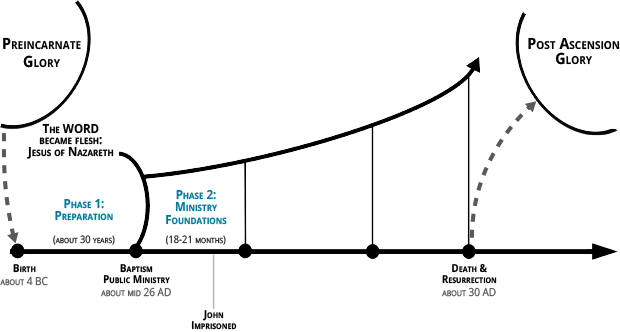
5. Label the diagram as you describe each phase:
Phase 1: Preparation
Write Phase 1: Preparation from birth of Jesus around 4 BC to about 30 years of age.
Summary: Becoming the person you seek to multiply, preparing for a Godly life and movement of multiplication.
40 And the child grew and became strong; he was filled with wisdom, and the grace of God was on him.
51 Then he went down to Nazareth with them and was obedient to them. But his mother treasured all these things in her heart.52 And Jesus grew in wisdom and stature, and in favour with God and man.
The Diagram for Phase 1 should look like this when complete:
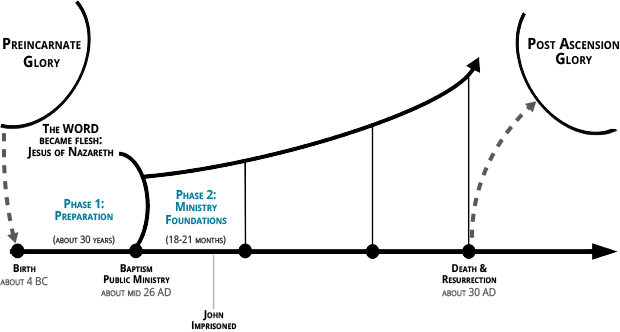
Phase 2: Ministry Foundations
Write Phase 2: Ministry Foundations about 18-21 months in the second box.
35 The next day John was there again with two of his disciples.36 When he saw Jesus passing by, he said, ‘Look, the Lamb of God!’
37 When the two disciples heard him say this, they followed Jesus.38 Turning round, Jesus saw them following and asked, ‘What do you want?’
They said, ‘Rabbi’ (which means ‘Teacher’), ‘where are you staying?’
39 ‘Come,’ he replied, ‘and you will see.’
So they went and saw where he was staying, and they spent that day with him. It was about four in the afternoon.
40 Andrew, Simon Peter’s brother, was one of the two who heard what John had said and who had followed Jesus.41 The first thing Andrew did was to find his brother Simon and tell him, ‘We have found the Messiah’ (that is, the Christ).42 And he brought him to Jesus.
Jesus looked at him and said, ‘You are Simon son of John. You will be called Cephas’ (which, when translated, is Peter).
43 The next day Jesus decided to leave for Galilee. Finding Philip, he said to him, ‘Follow me.’
44 Philip, like Andrew and Peter, was from the town of Bethsaida.45 Philip found Nathanael and told him, ‘We have found the one Moses wrote about in the Law, and about whom the prophets also wrote – Jesus of Nazareth, the son of Joseph.’
46 ‘Nazareth! Can anything good come from there?’ Nathanael asked.
‘Come and see,’ said Philip.
47 When Jesus saw Nathanael approaching, he said of him, ‘Here truly is an Israelite in whom there is no deceit.’
48 ‘How do you know me?’ Nathanael asked.
Jesus answered, ‘I saw you while you were still under the fig-tree before Philip called you.’
49 Then Nathanael declared, ‘Rabbi, you are the Son of God; you are the king of Israel.’
50 Jesus said, ‘You believe because I told you I saw you under the fig-tree. You will see greater things than that.’51 He then added, ‘Very truly I tell you, you will see “heaven open, and the angels of God ascending and descending on” the Son of Man.’
Holy Spirit dependence
P—Prayer
O—Obedience to the Kingdom agenda
W—the Word
E—Exalting the Father
R intentional Relationships
1 Now Jesus learned that the Pharisees had heard that he was gaining and baptising more disciples than John –2 although in fact it was not Jesus who baptised, but his disciples.3 So he left Judea and went back once more to Galilee.
4 Now he had to go through Samaria.
19 But when John rebuked Herod the tetrarch because of his marriage to Herodias, his brother’s wife, and all the other evil things he had done,20 Herod added this to them all: he locked John up in prison.
12 When Jesus heard that John had been put in prison, he withdrew to Galilee.
14 After John was put in prison, Jesus went into Galilee, proclaiming the good news of God.
14 Jesus returned to Galilee in the power of the Spirit, and news about him spread through the whole countryside.
The diagram for Phase 2 should look like this when complete.
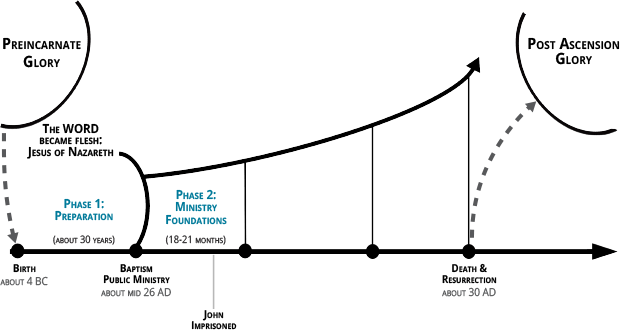
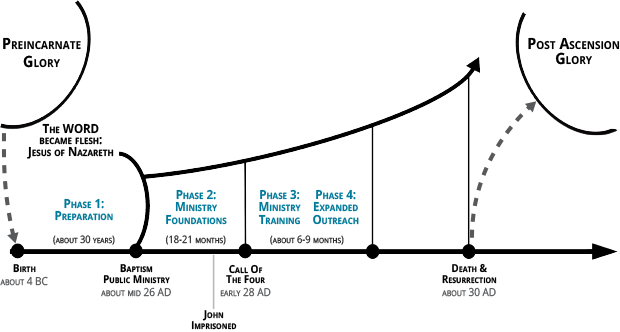
Phase 3: Ministry Training
Phase 4: Expanded Outreach
Write Phase 3: Ministry Training and Phase 4: Expanded Outreach in the middle box.
Then write About 6-9 months underneath.
Label the 3rd dot Call of the 4, Early 28 AD.
Summary: Phases 3 and 4 are happening simultaneously but represent two distinct phases. We see Jesus forming and training an expanding mission team as well as mobilizing for broader sowing and making new disciples. Jesus focused on a few and mobilized them for expanded mission. This phase starts with Jesus’ move to Capernaum and His call of the four to be fishers of men in early 28 AD.
14 Jesus returned to Galilee in the power of the Spirit, and news about him spread through the whole countryside.15 He was teaching in their synagogues, and everyone praised him.
16 He went to Nazareth, where he had been brought up, and on the Sabbath day he went into the synagogue, as was his custom. He stood up to read,17 and the scroll of the prophet Isaiah was handed to him. Unrolling it, he found the place where it is written:
18 ‘The Spirit of the Lord is on me,
because he has anointed me
to proclaim good news to the poor.
He has sent me to proclaim freedom for the prisoners
and recovery of sight for the blind,
to set the oppressed free,
19 to proclaim the year of the Lord’s favour.’
20 Then he rolled up the scroll, gave it back to the attendant and sat down. The eyes of everyone in the synagogue were fastened on him.21 He began by saying to them, ‘Today this scripture is fulfilled in your hearing.’
22 All spoke well of him and were amazed at the gracious words that came from his lips. ‘Isn’t this Joseph’s son?’ they asked.
23 Jesus said to them, ‘Surely you will quote this proverb to me: “Physician, heal yourself!” And you will tell me, “Do here in your home town what we have heard that you did in Capernaum.”’
24 ‘Truly I tell you,’ he continued, ‘no prophet is accepted in his home town.25 I assure you that there were many widows in Israel in Elijah’s time, when the sky was shut for three and a half years and there was a severe famine throughout the land.26 Yet Elijah was not sent to any of them, but to a widow in Zarephath in the region of Sidon.27 And there were many in Israel with leprosy in the time of Elisha the prophet, yet not one of them was cleansed – only Naaman the Syrian.’
28 All the people in the synagogue were furious when they heard this.29 They got up, drove him out of the town, and took him to the brow of the hill on which the town was built, in order to throw him off the cliff.30 But he walked right through the crowd and went on his way.
31 Then he went down to Capernaum, a town in Galilee, and on the Sabbath he taught the people.
13 Leaving Nazareth, he went and lived in Capernaum, which was by the lake in the area of Zebulun and Naphtali –14 to fulfil what was said through the prophet Isaiah:
15 ‘Land of Zebulun and land of Naphtali,
the Way of the Sea, beyond the Jordan,
Galilee of the Gentiles –
16 the people living in darkness
have seen a great light;
on those living in the land of the shadow of death
a light has dawned.’
14 After John was put in prison, Jesus went into Galilee, proclaiming the good news of God.15 ‘The time has come,’ he said. ‘The kingdom of God has come near. Repent and believe the good news!’
16 As Jesus walked beside the Sea of Galilee, he saw Simon and his brother Andrew casting a net into the lake, for they were fishermen.17 ‘Come, follow me,’ Jesus said, ‘and I will send you out to fish for people.’18 At once they left their nets and followed him.
19 When he had gone a little farther, he saw James son of Zebedee and his brother John in a boat, preparing their nets.20 Without delay he called them, and they left their father Zebedee in the boat with the hired men and followed him.
31 Then he went down to Capernaum, a town in Galilee, and on the Sabbath he taught the people.32 They were amazed at his teaching, because his words had authority.
33 In the synagogue there was a man possessed by a demon, an impure spirit. He cried out at the top of his voice,34 ‘Go away! What do you want with us, Jesus of Nazareth? Have you come to destroy us? I know who you are – the Holy One of God!’
35 ‘Be quiet!’ Jesus said sternly. ‘Come out of him!’ Then the demon threw the man down before them all and came out without injuring him.
36 All the people were amazed and said to each other, ‘What words these are! With authority and power he gives orders to impure spirits and they come out!’37 And the news about him spread throughout the surrounding area.
38 Jesus left the synagogue and went to the home of Simon. Now Simon’s mother-in-law was suffering from a high fever, and they asked Jesus to help her.39 So he bent over her and rebuked the fever, and it left her. She got up at once and began to wait on them.
40 At sunset, the people brought to Jesus all who had various kinds of illness, and laying his hands on each one, he healed them.41 Moreover, demons came out of many people, shouting, ‘You are the Son of God!’ But he rebuked them and would not allow them to speak, because they knew he was the Messiah.
42 At daybreak, Jesus went out to a solitary place. The people were looking for him and when they came to where he was, they tried to keep him from leaving them.43 But he said, ‘I must proclaim the good news of the kingdom of God to the other towns also, because that is why I was sent.’44 And he kept on preaching in the synagogues of Judea.
1 Another time Jesus went into the synagogue, and a man with a shrivelled hand was there.2 Some of them were looking for a reason to accuse Jesus, so they watched him closely to see if he would heal him on the Sabbath.3 Jesus said to the man with the shrivelled hand, ‘Stand up in front of everyone.’
4 Then Jesus asked them, ‘Which is lawful on the Sabbath: to do good or to do evil, to save life or to kill?’ But they remained silent.
5 He looked around at them in anger and, deeply distressed at their stubborn hearts, said to the man, ‘Stretch out your hand.’ He stretched it out, and his hand was completely restored.6 Then the Pharisees went out and began to plot with the Herodians how they might kill Jesus.
7 Jesus withdrew with his disciples to the lake, and a large crowd from Galilee followed.8 When they heard all he was doing, many people came to him from Judea, Jerusalem, Idumea, and the regions across the Jordan and around Tyre and Sidon.9 Because of the crowd he told his disciples to have a small boat ready for him, to keep the people from crowding him.10 For he had healed many, so that those with diseases were pushing forward to touch him.11 Whenever the impure spirits saw him, they fell down before him and cried out, ‘You are the Son of God.’12 But he gave them strict orders not to tell others about him.
15 Aware of this, Jesus withdrew from that place. A large crowd followed him, and he healed all who were ill.16 He warned them not to tell others about him.17 This was to fulfil what was spoken through the prophet Isaiah:
18 ‘Here is my servant whom I have chosen,
the one I love, in whom I delight;
I will put my Spirit on him,
and he will proclaim justice to the nations.
19 He will not quarrel or cry out;
no one will hear his voice in the streets.
20 A bruised reed he will not break,
and a smouldering wick he will not snuff out,
till he has brought justice through to victory.
21 In his name the nations will put their hope.’
The diagram for Phase 3 and 4 should look like this when complete.
Phase 5: Leadership Multiplication
Write Phase 5: Leadership Multiplication, About 15 Months in the last box. Label the 4rd dot Appointing of 12 Apostles, Late 28 AD.
Summary: Phase 5 lasts about 15 months from the appointing of the 12 Apostles to Jesus’ Ascension back to Heaven. The priorities were: selecting proven disciple makers, developing their leadership and sending them to continue the Father’s Kingdom agenda and mission. We see Jesus appointing, training, handing over and releasing the movement to the next generation of multipliers.
Here are some of the main activities of this phase:
13 Jesus went up on a mountainside and called to him those he wanted, and they came to him.14 He appointed twelve that they might be with him and that he might send them out to preach15 and to have authority to drive out demons.16 These are the twelve he appointed: Simon (to whom he gave the name Peter);17 James son of Zebedee and his brother John (to them he gave the name Boanerges, which means ‘sons of thunder’),18 Andrew, Philip, Bartholomew, Matthew, Thomas, James son of Alphaeus, Thaddaeus, Simon the Zealot19 and Judas Iscariot, who betrayed him.
2 When John, who was in prison, heard about the deeds of the Messiah, he sent his disciples3 to ask him, ‘Are you the one who is to come, or should we expect someone else?’
4 Jesus replied, ‘Go back and report to John what you hear and see:5 the blind receive sight, the lame walk, those who have leprosy are cleansed, the deaf hear, the dead are raised, and the good news is proclaimed to the poor.6 Blessed is anyone who does not stumble on account of me.’
7 As John’s disciples were leaving, Jesus began to speak to the crowd about John: ‘What did you go out into the wilderness to see? A reed swayed by the wind?8 If not, what did you go out to see? A man dressed in fine clothes? No, those who wear fine clothes are in kings’ palaces.9 Then what did you go out to see? A prophet? Yes, I tell you, and more than a prophet.10 This is the one about whom it is written:
‘“I will send my messenger ahead of you,
who will prepare your way before you.”
11 Truly I tell you, among those born of women there has not risen anyone greater than John the Baptist; yet whoever is least in the kingdom of heaven is greater than he.12 From the days of John the Baptist until now, the kingdom of heaven has been subjected to violence, and violent people have been raiding it.13 For all the Prophets and the Law prophesied until John.14 And if you are willing to accept it, he is the Elijah who was to come.15 Whoever has ears, let them hear.
16 ‘To what can I compare this generation? They are like children sitting in the market-places and calling out to others:
17 ‘“We played the pipe for you,
and you did not dance;
we sang a dirge,
and you did not mourn.”
18 For John came neither eating nor drinking, and they say, “He has a demon.”19 The Son of Man came eating and drinking, and they say, “Here is a glutton and a drunkard, a friend of tax collectors and sinners.” But wisdom is proved right by her deeds.’
1 After this, Jesus travelled about from one town and village to another, proclaiming the good news of the kingdom of God. The Twelve were with him,2 and also some women who had been cured of evil spirits and diseases: Mary (called Magdalene) from whom seven demons had come out;3 Joanna the wife of Chuza, the manager of Herod’s household; Susanna; and many others. These women were helping to support them out of their own means.
1 When Jesus had called the Twelve together, he gave them power and authority to drive out all demons and to cure diseases,2 and he sent them out to proclaim the kingdom of God and to heal those who were ill.3 He told them: ‘Take nothing for the journey – no staff, no bag, no bread, no money, no extra shirt.4 Whatever house you enter, stay there until you leave that town.5 If people do not welcome you, leave their town and shake the dust off your feet as a testimony against them.’6 So they set out and went from village to village, proclaiming the good news and healing people everywhere.
1 Jesus called his twelve disciples to him and gave them authority to drive out impure spirits and to heal every disease and illness.
2 These are the names of the twelve apostles: first, Simon (who is called Peter) and his brother Andrew; James son of Zebedee, and his brother John;3 Philip and Bartholomew; Thomas and Matthew the tax collector; James son of Alphaeus, and Thaddaeus;4 Simon the Zealot and Judas Iscariot, who betrayed him.
5 These twelve Jesus sent out with the following instructions: ‘Do not go among the Gentiles or enter any town of the Samaritans.6 Go rather to the lost sheep of Israel.7 As you go, proclaim this message: “The kingdom of heaven has come near.”8 Heal those who are ill, raise the dead, cleanse those who have leprosy, drive out demons. Freely you have received; freely give.
9 ‘Do not get any gold or silver or copper to take with you in your belts –10 no bag for the journey or extra shirt or sandals or a staff, for the worker is worth his keep.11 Whatever town or village you enter, search there for some worthy person and stay at their house until you leave.12 As you enter the home, give it your greeting.13 If the home is deserving, let your peace rest on it; if it is not, let your peace return to you.14 If anyone will not welcome you or listen to your words, leave that home or town and shake the dust off your feet.15 Truly I tell you, it will be more bearable for Sodom and Gomorrah on the day of judgment than for that town.
16 ‘I am sending you out like sheep among wolves. Therefore be as shrewd as snakes and as innocent as doves.17 Be on your guard; you will be handed over to the local councils and be flogged in the synagogues.18 On my account you will be brought before governors and kings as witnesses to them and to the Gentiles.19 But when they arrest you, do not worry about what to say or how to say it. At that time you will be given what to say,20 for it will not be you speaking, but the Spirit of your Father speaking through you.
21 ‘Brother will betray brother to death, and a father his child; children will rebel against their parents and have them put to death.22 You will be hated by everyone because of me, but the one who stands firm to the end will be saved.23 When you are persecuted in one place, flee to another. Truly I tell you, you will not finish going through the towns of Israel before the Son of Man comes.
24 ‘The student is not above the teacher, nor a servant above his master.25 It is enough for students to be like their teachers, and servants like their masters. If the head of the house has been called Beelzebul, how much more the members of his household!
26 ‘So do not be afraid of them, for there is nothing concealed that will not be disclosed, or hidden that will not be made known.27 What I tell you in the dark, speak in the daylight; what is whispered in your ear, proclaim from the roofs.28 Do not be afraid of those who kill the body but cannot kill the soul. Rather, be afraid of the One who can destroy both soul and body in hell.29 Are not two sparrows sold for a penny? Yet not one of them will fall to the ground outside your Father’s care.30 And even the very hairs of your head are all numbered.31 So don’t be afraid; you are worth more than many sparrows.
32 ‘Whoever acknowledges me before others, I will also acknowledge before my Father in heaven.33 But whoever disowns me before others, I will disown before my Father in heaven.
34 ‘Do not suppose that I have come to bring peace to the earth. I did not come to bring peace, but a sword.35 For I have come to turn
‘“a man against his father,
a daughter against her mother,
a daughter-in-law against her mother-in-law –
36 a man’s enemies will be the members of his own household.”
37 ‘Anyone who loves their father or mother more than me is not worthy of me; anyone who loves their son or daughter more than me is not worthy of me.38 Whoever does not take up their cross and follow me is not worthy of me.39 Whoever finds their life will lose it, and whoever loses their life for my sake will find it.
40 ‘Anyone who welcomes you welcomes me, and anyone who welcomes me welcomes the one who sent me.41 Whoever welcomes a prophet as a prophet will receive a prophet’s reward, and whoever welcomes a righteous person as a righteous person will receive a righteous person’s reward.42 And if anyone gives even a cup of cold water to one of these little ones who is my disciple, truly I tell you, that person will certainly not lose their reward.’
7 Calling the Twelve to him, he began to send them out two by two and gave them authority over impure spirits.
8 These were his instructions: ‘Take nothing for the journey except a staff – no bread, no bag, no money in your belts.9 Wear sandals but not an extra shirt.10 Whenever you enter a house, stay there until you leave that town.11 And if any place will not welcome you or listen to you, leave that place and shake the dust off your feet as a testimony against them.’
3 Now Herod had arrested John and bound him and put him in prison because of Herodias, his brother Philip’s wife,4 for John had been saying to him: ‘It is not lawful for you to have her.’5 Herod wanted to kill John, but he was afraid of the people, because they considered John a prophet.
6 On Herod’s birthday the daughter of Herodias danced for the guests and pleased Herod so much7 that he promised with an oath to give her whatever she asked.8 Prompted by her mother, she said, ‘Give me here on a dish the head of John the Baptist.’9 The king was distressed, but because of his oaths and his dinner guests, he ordered that her request be granted10 and had John beheaded in the prison.11 His head was brought in on a dish and given to the girl, who carried it to her mother.12 John’s disciples came and took his body and buried it. Then they went and told Jesus.
17 For Herod himself had given orders to have John arrested, and he had him bound and put in prison. He did this because of Herodias, his brother Philip’s wife, whom he had married.18 For John had been saying to Herod, ‘It is not lawful for you to have your brother’s wife.’19 So Herodias nursed a grudge against John and wanted to kill him. But she was not able to,20 because Herod feared John and protected him, knowing him to be a righteous and holy man. When Herod heard John, he was greatly puzzled; yet he liked to listen to him.
21 Finally the opportune time came. On his birthday Herod gave a banquet for his high officials and military commanders and the leading men of Galilee.22 When the daughter of Herodias came in and danced, she pleased Herod and his dinner guests.
The king said to the girl, ‘Ask me for anything you want, and I’ll give it to you.’23 And he promised her with an oath, ‘Whatever you ask I will give you, up to half my kingdom.’
24 She went out and said to her mother, ‘What shall I ask for?’
‘The head of John the Baptist,’ she answered.
25 At once the girl hurried in to the king with the request: ‘I want you to give me right now the head of John the Baptist on a dish.’
26 The king was greatly distressed, but because of his oaths and his dinner guests, he did not want to refuse her.27 So he immediately sent an executioner with orders to bring John’s head. The man went, beheaded John in the prison,28 and brought back his head on a dish. He presented it to the girl, and she gave it to her mother.29 On hearing of this, John’s disciples came and took his body and laid it in a tomb.
10 When the apostles returned, they reported to Jesus what they had done. Then he took them with him and they withdrew by themselves to a town called Bethsaida,11 but the crowds learned about it and followed him. He welcomed them and spoke to them about the kingdom of God, and healed those who needed healing.
13 When Jesus heard what had happened, he withdrew by boat privately to a solitary place. Hearing of this, the crowds followed him on foot from the towns.14 When Jesus landed and saw a large crowd, he had compassion on them and healed those who were ill.
31 Then, because so many people were coming and going that they did not even have a chance to eat, he said to them, ‘Come with me by yourselves to a quiet place and get some rest.’
32 So they went away by themselves in a boat to a solitary place.33 But many who saw them leaving recognised them and ran on foot from all the towns and got there ahead of them.34 When Jesus landed and saw a large crowd, he had compassion on them, because they were like sheep without a shepherd. So he began teaching them many things.
1 Some time after this, Jesus crossed to the far shore of the Sea of Galilee (that is, the Sea of Tiberias),2 and a great crowd of people followed him because they saw the signs he had performed by healing those who were ill.3 Then Jesus went up on a mountainside and sat down with his disciples.
14 After the people saw the sign Jesus performed, they began to say, ‘Surely this is the Prophet who is to come into the world.’15 Jesus, knowing that they intended to come and make him king by force, withdrew again to a mountain by himself.
22 Immediately Jesus made the disciples get into the boat and go on ahead of him to the other side, while he dismissed the crowd.23 After he had dismissed them, he went up on a mountainside by himself to pray. Later that night, he was there alone,
45 Immediately Jesus made his disciples get into the boat and go on ahead of him to Bethsaida, while he dismissed the crowd.46 After leaving them, he went up on a mountainside to pray.
13 When Jesus came to the region of Caesarea Philippi, he asked his disciples, ‘Who do people say the Son of Man is?’
14 They replied, ‘Some say John the Baptist; others say Elijah; and still others, Jeremiah or one of the prophets.’
15 ‘But what about you?’ he asked. ‘Who do you say I am?’
16 Simon Peter answered, ‘You are the Messiah, the Son of the living God.’
17 Jesus replied, ‘Blessed are you, Simon son of Jonah, for this was not revealed to you by flesh and blood, but by my Father in heaven.18 And I tell you that you are Peter, and on this rock I will build my church, and the gates of Hades will not overcome it.19 I will give you the keys of the kingdom of heaven; whatever you bind on earth will be bound in heaven, and whatever you loose on earth will be loosed in heaven.’20 Then he ordered his disciples not to tell anyone that he was the Messiah.
21 From that time on Jesus began to explain to his disciples that he must go to Jerusalem and suffer many things at the hands of the elders, the chief priests and the teachers of the law, and that he must be killed and on the third day be raised to life.
22 Peter took him aside and began to rebuke him. ‘Never, Lord!’ he said. ‘This shall never happen to you!’
23 Jesus turned and said to Peter, ‘Get behind me, Satan! You are a stumbling-block to me; you do not have in mind the concerns of God, but merely human concerns.’
24 Then Jesus said to his disciples, ‘Whoever wants to be my disciple must deny themselves and take up their cross and follow me.25 For whoever wants to save their life will lose it, but whoever loses their life for me will find it.26 What good will it be for someone to gain the whole world, yet forfeit their soul? Or what can anyone give in exchange for their soul?
1 After this the Lord appointed seventy-two others and sent them two by two ahead of him to every town and place where he was about to go.2 He told them, ‘The harvest is plentiful, but the workers are few. Ask the Lord of the harvest, therefore, to send out workers into his harvest field.3 Go! I am sending you out like lambs among wolves.4 Do not take a purse or bag or sandals; and do not greet anyone on the road.
5 ‘When you enter a house, first say, “Peace to this house.”6 If someone who promotes peace is there, your peace will rest on them; if not, it will return to you.7 Stay there, eating and drinking whatever they give you, for the worker deserves his wages. Do not move around from house to house.
8 ‘When you enter a town and are welcomed, eat what is offered to you.9 Heal those there who are ill and tell them, “The kingdom of God has come near to you.”10 But when you enter a town and are not welcomed, go into its streets and say,11 “Even the dust of your town we wipe from our feet as a warning to you. Yet be sure of this: the kingdom of God has come near.”12 I tell you, it will be more bearable on that day for Sodom than for that town.
13 ‘Woe to you, Chorazin! Woe to you, Bethsaida! For if the miracles that were performed in you had been performed in Tyre and Sidon, they would have repented long ago, sitting in sackcloth and ashes.14 But it will be more bearable for Tyre and Sidon at the judgment than for you.15 And you, Capernaum, will you be lifted to the heavens? No, you will go down to Hades.
16 ‘Whoever listens to you listens to me; whoever rejects you rejects me; but whoever rejects me rejects him who sent me.’
17 The seventy-two returned with joy and said, ‘Lord, even the demons submit to us in your name.’
18 He replied, ‘I saw Satan fall like lightning from heaven.19 I have given you authority to trample on snakes and scorpions and to overcome all the power of the enemy; nothing will harm you.20 However, do not rejoice that the spirits submit to you, but rejoice that your names are written in heaven.’
21 At that time Jesus, full of joy through the Holy Spirit, said, ‘I praise you, Father, Lord of heaven and earth, because you have hidden these things from the wise and learned, and revealed them to little children. Yes, Father, for this is what you were pleased to do.
22 ‘All things have been committed to me by my Father. No one knows who the Son is except the Father, and no one knows who the Father is except the Son and those to whom the Son chooses to reveal him.’
23 Then he turned to his disciples and said privately, ‘Blessed are the eyes that see what you see.24 For I tell you that many prophets and kings wanted to see what you see but did not see it, and to hear what you hear but did not hear it.’
25 On one occasion an expert in the law stood up to test Jesus. ‘Teacher,’ he asked, ‘what must I do to inherit eternal life?’
26 ‘What is written in the Law?’ he replied. ‘How do you read it?’
27 He answered, ‘“Love the Lord your God with all your heart and with all your soul and with all your strength and with all your mind”; and, “Love your neighbour as yourself.”’
28 ‘You have answered correctly,’ Jesus replied. ‘Do this and you will live.’
29 But he wanted to justify himself, so he asked Jesus, ‘And who is my neighbour?’
30 In reply Jesus said: ‘A man was going down from Jerusalem to Jericho, when he was attacked by robbers. They stripped him of his clothes, beat him and went away, leaving him half-dead.31 A priest happened to be going down the same road, and when he saw the man, he passed by on the other side.32 So too, a Levite, when he came to the place and saw him, passed by on the other side.33 But a Samaritan, as he travelled, came where the man was; and when he saw him, he took pity on him.34 He went to him and bandaged his wounds, pouring on oil and wine. Then he put the man on his own donkey, brought him to an inn and took care of him.35 The next day he took out two denarii and gave them to the innkeeper. “Look after him,” he said, “and when I return, I will reimburse you for any extra expense you may have.”
36 ‘Which of these three do you think was a neighbour to the man who fell into the hands of robbers?’
37 The expert in the law replied, ‘The one who had mercy on him.’
Jesus told him, ‘Go and do likewise.’
38 As Jesus and his disciples were on their way, he came to a village where a woman named Martha opened her home to him.39 She had a sister called Mary, who sat at the Lord’s feet listening to what he said.40 But Martha was distracted by all the preparations that had to be made. She came to him and asked, ‘Lord, don’t you care that my sister has left me to do the work by myself? Tell her to help me!’
41 ‘Martha, Martha,’ the Lord answered, ‘you are worried and upset about many things,42 but few things are needed – or indeed only one. Mary has chosen what is better, and it will not be taken away from her.’
1 One day Jesus was praying in a certain place. When he finished, one of his disciples said to him, ‘Lord, teach us to pray, just as John taught his disciples.’
2 He said to them, ‘When you pray, say:
‘“Father,
hallowed be your name,
your kingdom come.
3 Give us each day our daily bread.
4 Forgive us our sins,
for we also forgive everyone who sins against us.
And lead us not into temptation.”’
5 Then Jesus said to them, ‘Suppose you have a friend, and you go to him at midnight and say, “Friend, lend me three loaves of bread;6 a friend of mine on a journey has come to me, and I have no food to offer him.”7 And suppose the one inside answers, “Don’t bother me. The door is already locked, and my children and I are in bed. I can’t get up and give you anything.”8 I tell you, even though he will not get up and give you the bread because of friendship, yet because of your shameless audacity he will surely get up and give you as much as you need.
9 ‘So I say to you: ask and it will be given to you; seek and you will find; knock and the door will be opened to you.10 For everyone who asks receives; the one who seeks finds; and to the one who knocks, the door will be opened.
11 ‘Which of you fathers, if your son asks for a fish, will give him a snake instead?12 Or if he asks for an egg, will give him a scorpion?13 If you then, though you are evil, know how to give good gifts to your children, how much more will your Father in heaven give the Holy Spirit to those who ask him!’
14 Jesus was driving out a demon that was mute. When the demon left, the man who had been mute spoke, and the crowd was amazed.15 But some of them said, ‘By Beelzebul, the prince of demons, he is driving out demons.’16 Others tested him by asking for a sign from heaven.
17 Jesus knew their thoughts and said to them: ‘Any kingdom divided against itself will be ruined, and a house divided against itself will fall.18 If Satan is divided against himself, how can his kingdom stand? I say this because you claim that I drive out demons by Beelzebul.19 Now if I drive out demons by Beelzebul, by whom do your followers drive them out? So then, they will be your judges.20 But if I drive out demons by the finger of God, then the kingdom of God has come upon you.
21 ‘When a strong man, fully armed, guards his own house, his possessions are safe.22 But when someone stronger attacks and overpowers him, he takes away the armour in which the man trusted and divides up his plunder.
23 ‘Whoever is not with me is against me, and whoever does not gather with me scatters.
24 ‘When an impure spirit comes out of a person, it goes through arid places seeking rest and does not find it. Then it says, “I will return to the house I left.”25 When it arrives, it finds the house swept clean and put in order.26 Then it goes and takes seven other spirits more wicked than itself, and they go in and live there. And the final condition of that person is worse than the first.’
27 As Jesus was saying these things, a woman in the crowd called out, ‘Blessed is the mother who gave you birth and nursed you.’
28 He replied, ‘Blessed rather are those who hear the word of God and obey it.’
29 As the crowds increased, Jesus said, ‘This is a wicked generation. It asks for a sign, but none will be given it except the sign of Jonah.30 For as Jonah was a sign to the Ninevites, so also will the Son of Man be to this generation.31 The Queen of the South will rise at the judgment with the people of this generation and condemn them, for she came from the ends of the earth to listen to Solomon’s wisdom; and now something greater than Solomon is here.32 The men of Nineveh will stand up at the judgment with this generation and condemn it, for they repented at the preaching of Jonah; and now something greater than Jonah is here.
33 ‘No one lights a lamp and puts it in a place where it will be hidden, or under a bowl. Instead they put it on its stand, so that those who come in may see the light.34 Your eye is the lamp of your body. When your eyes are healthy, your whole body also is full of light. But when they are unhealthy, your body also is full of darkness.35 See to it, then, that the light within you is not darkness.36 Therefore, if your whole body is full of light, and no part of it dark, it will be just as full of light as when a lamp shines its light on you.’
37 When Jesus had finished speaking, a Pharisee invited him to eat with him; so he went in and reclined at the table.38 But the Pharisee was surprised when he noticed that Jesus did not first wash before the meal.
39 Then the Lord said to him, ‘Now then, you Pharisees clean the outside of the cup and dish, but inside you are full of greed and wickedness.40 You foolish people! Did not the one who made the outside make the inside also?41 But now as for what is inside you – be generous to the poor, and everything will be clean for you.
42 ‘Woe to you Pharisees, because you give God a tenth of your mint, rue and all other kinds of garden herbs, but you neglect justice and the love of God. You should have practised the latter without leaving the former undone.
43 ‘Woe to you Pharisees, because you love the most important seats in the synagogues and respectful greetings in the market-places.
44 ‘Woe to you, because you are like unmarked graves, which people walk over without knowing it.’
45 One of the experts in the law answered him, ‘Teacher, when you say these things, you insult us also.’
46 Jesus replied, ‘And you experts in the law, woe to you, because you load people down with burdens they can hardly carry, and you yourselves will not lift one finger to help them.
47 ‘Woe to you, because you build tombs for the prophets, and it was your ancestors who killed them.48 So you testify that you approve of what your ancestors did; they killed the prophets, and you build their tombs.49 Because of this, God in his wisdom said, “I will send them prophets and apostles, some of whom they will kill and others they will persecute.”50 Therefore this generation will be held responsible for the blood of all the prophets that has been shed since the beginning of the world,51 from the blood of Abel to the blood of Zechariah, who was killed between the altar and the sanctuary. Yes, I tell you, this generation will be held responsible for it all.
52 ‘Woe to you experts in the law, because you have taken away the key to knowledge. You yourselves have not entered, and you have hindered those who were entering.’
53 When Jesus went outside, the Pharisees and the teachers of the law began to oppose him fiercely and to besiege him with questions,54 waiting to catch him in something he might say.
1 Meanwhile, when a crowd of many thousands had gathered, so that they were trampling on one another, Jesus began to speak first to his disciples, saying: ‘Be on your guard against the yeast of the Pharisees, which is hypocrisy.2 There is nothing concealed that will not be disclosed, or hidden that will not be made known.3 What you have said in the dark will be heard in the daylight, and what you have whispered in the ear in the inner rooms will be proclaimed from the roofs.
4 ‘I tell you, my friends, do not be afraid of those who kill the body and after that can do no more.5 But I will show you whom you should fear: fear him who, after your body has been killed, has authority to throw you into hell. Yes, I tell you, fear him.6 Are not five sparrows sold for two pennies? Yet not one of them is forgotten by God.7 Indeed, the very hairs of your head are all numbered. Don’t be afraid; you are worth more than many sparrows.
8 ‘I tell you, whoever publicly acknowledges me before others, the Son of Man will also acknowledge before the angels of God.9 But whoever disowns me before others will be disowned before the angels of God.10 And everyone who speaks a word against the Son of Man will be forgiven, but anyone who blasphemes against the Holy Spirit will not be forgiven.
11 ‘When you are brought before synagogues, rulers and authorities, do not worry about how you will defend yourselves or what you will say,12 for the Holy Spirit will teach you at that time what you should say.’
13 Someone in the crowd said to him, ‘Teacher, tell my brother to divide the inheritance with me.’
14 Jesus replied, ‘Man, who appointed me a judge or an arbiter between you?’15 Then he said to them, ‘Watch out! Be on your guard against all kinds of greed; life does not consist in an abundance of possessions.’
16 And he told them this parable: ‘The ground of a certain rich man yielded an abundant harvest.17 He thought to himself, “What shall I do? I have no place to store my crops.”
18 ‘Then he said, “This is what I’ll do. I will tear down my barns and build bigger ones, and there I will store my surplus grain.19 And I’ll say to myself, ‘You have plenty of grain laid up for many years. Take life easy; eat, drink and be merry.’”
20 ‘But God said to him, “You fool! This very night your life will be demanded from you. Then who will get what you have prepared for yourself?”
21 ‘This is how it will be with whoever stores up things for themselves but is not rich towards God.’
22 Then Jesus said to his disciples: ‘Therefore I tell you, do not worry about your life, what you will eat; or about your body, what you will wear.23 For life is more than food, and the body more than clothes.24 Consider the ravens: they do not sow or reap, they have no storeroom or barn; yet God feeds them. And how much more valuable you are than birds!25 Who of you by worrying can add a single hour to your life?26 Since you cannot do this very little thing, why do you worry about the rest?
27 ‘Consider how the wild flowers grow. They do not labour or spin. Yet I tell you, not even Solomon in all his splendour was dressed like one of these.28 If that is how God clothes the grass of the field, which is here today, and tomorrow is thrown into the fire, how much more will he clothe you – you of little faith!29 And do not set your heart on what you will eat or drink; do not worry about it.30 For the pagan world runs after all such things, and your Father knows that you need them.31 But seek his kingdom, and these things will be given to you as well.
32 ‘Do not be afraid, little flock, for your Father has been pleased to give you the kingdom.33 Sell your possessions and give to the poor. Provide purses for yourselves that will not wear out, a treasure in heaven that will never fail, where no thief comes near and no moth destroys.34 For where your treasure is, there your heart will be also.
35 ‘Be dressed ready for service and keep your lamps burning,36 like servants waiting for their master to return from a wedding banquet, so that when he comes and knocks they can immediately open the door for him.37 It will be good for those servants whose master finds them watching when he comes. Truly I tell you, he will dress himself to serve, will make them recline at the table and will come and wait on them.38 It will be good for those servants whose master finds them ready, even if he comes in the middle of the night or towards daybreak.39 But understand this: if the owner of the house had known at what hour the thief was coming, he would not have let his house be broken into.40 You also must be ready, because the Son of Man will come at an hour when you do not expect him.’
41 Peter asked, ‘Lord, are you telling this parable to us, or to everyone?’
42 The Lord answered, ‘Who then is the faithful and wise manager, whom the master puts in charge of his servants to give them their food allowance at the proper time?43 It will be good for that servant whom the master finds doing so when he returns.44 Truly I tell you, he will put him in charge of all his possessions.45 But suppose the servant says to himself, “My master is taking a long time in coming,” and he then begins to beat the other servants, both men and women, and to eat and drink and get drunk.46 The master of that servant will come on a day when he does not expect him and at an hour he is not aware of. He will cut him to pieces and assign him a place with the unbelievers.
47 ‘The servant who knows the master’s will and does not get ready or does not do what the master wants will be beaten with many blows.48 But the one who does not know and does things deserving punishment will be beaten with few blows. From everyone who has been given much, much will be demanded; and from the one who has been entrusted with much, much more will be asked.
49 ‘I have come to bring fire on the earth, and how I wish it were already kindled!50 But I have a baptism to undergo, and what constraint I am under until it is completed!51 Do you think I came to bring peace on earth? No, I tell you, but division.52 From now on there will be five in one family divided against each other, three against two and two against three.53 They will be divided, father against son and son against father, mother against daughter and daughter against mother, mother-in-law against daughter-in-law and daughter-in-law against mother-in-law.’
54 He said to the crowd: ‘When you see a cloud rising in the west, immediately you say, “It’s going to rain,” and it does.55 And when the south wind blows, you say, “It’s going to be hot,” and it is.56 Hypocrites! You know how to interpret the appearance of the earth and the sky. How is it that you don’t know how to interpret this present time?
57 ‘Why don’t you judge for yourselves what is right?58 As you are going with your adversary to the magistrate, try hard to be reconciled on the way, or your adversary may drag you off to the judge, and the judge turn you over to the officer, and the officer throw you into prison.59 I tell you, you will not get out until you have paid the last penny.’
1 Now there were some present at that time who told Jesus about the Galileans whose blood Pilate had mixed with their sacrifices.2 Jesus answered, ‘Do you think that these Galileans were worse sinners than all the other Galileans because they suffered this way?3 I tell you, no! But unless you repent, you too will all perish.4 Or those eighteen who died when the tower in Siloam fell on them – do you think they were more guilty than all the others living in Jerusalem?5 I tell you, no! But unless you repent, you too will all perish.’
6 Then he told this parable: ‘A man had a fig-tree growing in his vineyard, and he went to look for fruit on it but did not find any.7 So he said to the man who took care of the vineyard, “For three years now I’ve been coming to look for fruit on this fig-tree and haven’t found any. Cut it down! Why should it use up the soil?”
8 ‘“Sir,” the man replied, “leave it alone for one more year, and I’ll dig round it and fertilise it.9 If it bears fruit next year, fine! If not, then cut it down.”’
10 On a Sabbath Jesus was teaching in one of the synagogues,11 and a woman was there who had been crippled by a spirit for eighteen years. She was bent over and could not straighten up at all.12 When Jesus saw her, he called her forward and said to her, ‘Woman, you are set free from your infirmity.’13 Then he put his hands on her, and immediately she straightened up and praised God.
14 Indignant because Jesus had healed on the Sabbath, the synagogue leader said to the people, ‘There are six days for work. So come and be healed on those days, not on the Sabbath.’
15 The Lord answered him, ‘You hypocrites! Doesn’t each of you on the Sabbath untie your ox or donkey from the stall and lead it out to give it water?16 Then should not this woman, a daughter of Abraham, whom Satan has kept bound for eighteen long years, be set free on the Sabbath day from what bound her?’
17 When he said this, all his opponents were humiliated, but the people were delighted with all the wonderful things he was doing.
18 Then Jesus asked, ‘What is the kingdom of God like? What shall I compare it to?19 It is like a mustard seed, which a man took and planted in his garden. It grew and became a tree, and the birds perched in its branches.’
20 Again he asked, ‘What shall I compare the kingdom of God to?21 It is like yeast that a woman took and mixed into about thirty kilograms of flour until it worked all through the dough.’
22 Then Jesus went through the towns and villages, teaching as he made his way to Jerusalem.23 Someone asked him, ‘Lord, are only a few people going to be saved?’
He said to them,24 ‘Make every effort to enter through the narrow door, because many, I tell you, will try to enter and will not be able to.25 Once the owner of the house gets up and closes the door, you will stand outside knocking and pleading, “Sir, open the door for us.”
‘But he will answer, “I don’t know you or where you come from.”
26 ‘Then you will say, “We ate and drank with you, and you taught in our streets.”
27 ‘But he will reply, “I don’t know you or where you come from. Away from me, all you evildoers!”
28 ‘There will be weeping there, and gnashing of teeth, when you see Abraham, Isaac and Jacob and all the prophets in the kingdom of God, but you yourselves thrown out.29 People will come from east and west and north and south, and will take their places at the feast in the kingdom of God.30 Indeed there are those who are last who will be first, and first who will be last.’
31 At that time some Pharisees came to Jesus and said to him, ‘Leave this place and go somewhere else. Herod wants to kill you.’
32 He replied, ‘Go and tell that fox, “I will keep on driving out demons and healing people today and tomorrow, and on the third day I will reach my goal.”33 In any case, I must press on today and tomorrow and the next day – for surely no prophet can die outside Jerusalem!
34 ‘Jerusalem, Jerusalem, you who kill the prophets and stone those sent to you, how often I have longed to gather your children together, as a hen gathers her chicks under her wings, and you were not willing.35 Look, your house is left to you desolate. I tell you, you will not see me again until you say, “Blessed is he who comes in the name of the Lord.”’
1 One Sabbath, when Jesus went to eat in the house of a prominent Pharisee, he was being carefully watched.2 There in front of him was a man suffering from abnormal swelling of his body.3 Jesus asked the Pharisees and experts in the law, ‘Is it lawful to heal on the Sabbath or not?’4 But they remained silent. So taking hold of the man, he healed him and sent him on his way.
5 Then he asked them, ‘If one of you has a child or an ox that falls into a well on the Sabbath day, will you not immediately pull it out?’6 And they had nothing to say.
7 When he noticed how the guests picked the places of honour at the table, he told them this parable:8 ‘When someone invites you to a wedding feast, do not take the place of honour, for a person more distinguished than you may have been invited.9 If so, the host who invited both of you will come and say to you, “Give this person your seat.” Then, humiliated, you will have to take the least important place.10 But when you are invited, take the lowest place, so that when your host comes, he will say to you, “Friend, move up to a better place.” Then you will be honoured in the presence of all the other guests.11 For all those who exalt themselves will be humbled, and those who humble themselves will be exalted.’
12 Then Jesus said to his host, ‘When you give a luncheon or dinner, do not invite your friends, your brothers or sisters, your relatives, or your rich neighbours; if you do, they may invite you back and so you will be repaid.13 But when you give a banquet, invite the poor, the crippled, the lame, the blind,14 and you will be blessed. Although they cannot repay you, you will be repaid at the resurrection of the righteous.’
15 When one of those at the table with him heard this, he said to Jesus, ‘Blessed is the one who will eat at the feast in the kingdom of God.’
16 Jesus replied: ‘A certain man was preparing a great banquet and invited many guests.17 At the time of the banquet he sent his servant to tell those who had been invited, “Come, for everything is now ready.”
18 ‘But they all alike began to make excuses. The first said, “I have just bought a field, and I must go and see it. Please excuse me.”
19 ‘Another said, “I have just bought five yoke of oxen, and I’m on my way to try them out. Please excuse me.”
20 ‘Still another said, “I have just got married, so I can’t come.”
21 ‘The servant came back and reported this to his master. Then the owner of the house became angry and ordered his servant, “Go out quickly into the streets and alleys of the town and bring in the poor, the crippled, the blind and the lame.”
22 ‘“Sir,” the servant said, “what you ordered has been done, but there is still room.”
23 ‘Then the master told his servant, “Go out to the roads and country lanes and compel them to come in, so that my house will be full.24 I tell you, not one of those who were invited will get a taste of my banquet.”’
25 Large crowds were travelling with Jesus, and turning to them he said:26 ‘If anyone comes to me and does not hate father and mother, wife and children, brothers and sisters – yes, even their own life – such a person cannot be my disciple.27 And whoever does not carry their cross and follow me cannot be my disciple.
28 ‘Suppose one of you wants to build a tower. Won’t you first sit down and estimate the cost to see if you have enough money to complete it?29 For if you lay the foundation and are not able to finish it, everyone who sees it will ridicule you,30 saying, “This person began to build and wasn’t able to finish.”
31 ‘Or suppose a king is about to go to war against another king. Won’t he first sit down and consider whether he is able with ten thousand men to oppose the one coming against him with twenty thousand?32 If he is not able, he will send a delegation while the other is still a long way off and will ask for terms of peace.33 In the same way, those of you who do not give up everything you have cannot be my disciples.
34 ‘Salt is good, but if it loses its saltiness, how can it be made salty again?35 It is fit neither for the soil nor for the manure heap; it is thrown out.
‘Whoever has ears to hear, let them hear.’
1 Now the tax collectors and sinners were all gathering round to hear Jesus.2 But the Pharisees and the teachers of the law muttered, ‘This man welcomes sinners, and eats with them.’
3 Then Jesus told them this parable:4 ‘Suppose one of you has a hundred sheep and loses one of them. Doesn’t he leave the ninety-nine in the open country and go after the lost sheep until he finds it?5 And when he finds it, he joyfully puts it on his shoulders6 and goes home. Then he calls his friends and neighbours together and says, “Rejoice with me; I have found my lost sheep.”7 I tell you that in the same way there will be more rejoicing in heaven over one sinner who repents than over ninety-nine righteous people who do not need to repent.
8 ‘Or suppose a woman has ten silver coins and loses one. Doesn’t she light a lamp, sweep the house and search carefully until she finds it?9 And when she finds it, she calls her friends and neighbours together and says, “Rejoice with me; I have found my lost coin.”10 In the same way, I tell you, there is rejoicing in the presence of the angels of God over one sinner who repents.’
11 Jesus continued: ‘There was a man who had two sons.12 The younger one said to his father, “Father, give me my share of the estate.” So he divided his property between them.
13 ‘Not long after that, the younger son got together all he had, set off for a distant country and there squandered his wealth in wild living.14 After he had spent everything, there was a severe famine in that whole country, and he began to be in need.15 So he went and hired himself out to a citizen of that country, who sent him to his fields to feed pigs.16 He longed to fill his stomach with the pods that the pigs were eating, but no one gave him anything.
17 ‘When he came to his senses, he said, “How many of my father’s hired servants have food to spare, and here I am starving to death!18 I will set out and go back to my father and say to him: Father, I have sinned against heaven and against you.19 I am no longer worthy to be called your son; make me like one of your hired servants.”20 So he got up and went to his father.
‘But while he was still a long way off, his father saw him and was filled with compassion for him; he ran to his son, threw his arms round him and kissed him.
21 ‘The son said to him, “Father, I have sinned against heaven and against you. I am no longer worthy to be called your son.”
22 ‘But the father said to his servants, “Quick! Bring the best robe and put it on him. Put a ring on his finger and sandals on his feet.23 Bring the fattened calf and kill it. Let’s have a feast and celebrate.24 For this son of mine was dead and is alive again; he was lost and is found.” So they began to celebrate.
25 ‘Meanwhile, the elder son was in the field. When he came near the house, he heard music and dancing.26 So he called one of the servants and asked him what was going on.27 “Your brother has come,” he replied, “and your father has killed the fattened calf because he has him back safe and sound.”
28 ‘The elder brother became angry and refused to go in. So his father went out and pleaded with him.29 But he answered his father, “Look! All these years I’ve been slaving for you and never disobeyed your orders. Yet you never gave me even a young goat so I could celebrate with my friends.30 But when this son of yours who has squandered your property with prostitutes comes home, you kill the fattened calf for him!”
31 ‘“My son,” the father said, “you are always with me, and everything I have is yours.32 But we had to celebrate and be glad, because this brother of yours was dead and is alive again; he was lost and is found.”’
1 Jesus told his disciples: ‘There was a rich man whose manager was accused of wasting his possessions.2 So he called him in and asked him, “What is this I hear about you? Give an account of your management, because you cannot be manager any longer.”
3 ‘The manager said to himself, “What shall I do now? My master is taking away my job. I’m not strong enough to dig, and I’m ashamed to beg –4 I know what I’ll do so that, when I lose my job here, people will welcome me into their houses.”
5 ‘So he called in each one of his master’s debtors. He asked the first, “How much do you owe my master?”
6 ‘“Three thousand litres of olive oil,” he replied.
‘The manager told him, “Take your bill, sit down quickly, and make it fifteen hundred.”
7 ‘Then he asked the second, “And how much do you owe?”
‘“Thirty tons of wheat,” he replied.
‘He told him, “Take your bill and make it twenty-four.”
8 ‘The master commended the dishonest manager because he had acted shrewdly. For the people of this world are more shrewd in dealing with their own kind than are the people of the light.9 I tell you, use worldly wealth to gain friends for yourselves, so that when it is gone, you will be welcomed into eternal dwellings.
10 ‘Whoever can be trusted with very little can also be trusted with much, and whoever is dishonest with very little will also be dishonest with much.11 So if you have not been trustworthy in handling worldly wealth, who will trust you with true riches?12 And if you have not been trustworthy with someone else’s property, who will give you property of your own?
13 ‘No one can serve two masters. Either you will hate the one and love the other, or you will be devoted to the one and despise the other. You cannot serve both God and Money.’
14 The Pharisees, who loved money, heard all this and were sneering at Jesus.15 He said to them, ‘You are the ones who justify yourselves in the eyes of others, but God knows your hearts. What people value highly is detestable in God’s sight.
16 ‘The Law and the Prophets were proclaimed until John. Since that time, the good news of the kingdom of God is being preached, and everyone is forcing their way into it.17 It is easier for heaven and earth to disappear than for the least stroke of a pen to drop out of the Law.
29 As he approached Bethphage and Bethany at the hill called the Mount of Olives, he sent two of his disciples, saying to them,30 ‘Go to the village ahead of you, and as you enter it, you will find a colt tied there, which no one has ever ridden. Untie it and bring it here.31 If anyone asks you, “Why are you untying it?” say, “The Lord needs it.”’
32 Those who were sent ahead went and found it just as he had told them.33 As they were untying the colt, its owners asked them, ‘Why are you untying the colt?’
34 They replied, ‘The Lord needs it.’
35 They brought it to Jesus, threw their cloaks on the colt and put Jesus on it.36 As he went along, people spread their cloaks on the road.
37 When he came near the place where the road goes down the Mount of Olives, the whole crowd of disciples began joyfully to praise God in loud voices for all the miracles they had seen:
38 ‘Blessed is the king who comes in the name of the Lord!’
‘Peace in heaven and glory in the highest!’
39 Some of the Pharisees in the crowd said to Jesus, ‘Teacher, rebuke your disciples!’
40 ‘I tell you,’ he replied, ‘if they keep quiet, the stones will cry out.’
41 As he approached Jerusalem and saw the city, he wept over it42 and said, ‘If you, even you, had only known on this day what would bring you peace – but now it is hidden from your eyes.43 The days will come upon you when your enemies will build an embankment against you and encircle you and hem you in on every side.44 They will dash you to the ground, you and the children within your walls. They will not leave one stone on another, because you did not recognise the time of God’s coming to you.’
45 When Jesus entered the temple courts, he began to drive out those who were selling.46 ‘It is written,’ he said to them, ‘“My house will be a house of prayer”; but you have made it “a den of robbers”.’
47 Every day he was teaching at the temple. But the chief priests, the teachers of the law and the leaders among the people were trying to kill him.48 Yet they could not find any way to do it, because all the people hung on his words.
1 One day as Jesus was teaching the people in the temple courts and proclaiming the good news, the chief priests and the teachers of the law, together with the elders, came up to him.2 ‘Tell us by what authority you are doing these things,’ they said. ‘Who gave you this authority?’
3 He replied, ‘I will also ask you a question. Tell me:4 John’s baptism – was it from heaven, or of human origin?’
5 They discussed it among themselves and said, ‘If we say, “From heaven,” he will ask, “Why didn’t you believe him?”6 But if we say, “Of human origin,” all the people will stone us, because they are persuaded that John was a prophet.’
7 So they answered, ‘We don’t know where it was from.’
8 Jesus said, ‘Neither will I tell you by what authority I am doing these things.’
9 He went on to tell the people this parable: ‘A man planted a vineyard, rented it to some farmers and went away for a long time.10 At harvest time he sent a servant to the tenants so they would give him some of the fruit of the vineyard. But the tenants beat him and sent him away empty-handed.11 He sent another servant, but that one also they beat and treated shamefully and sent away empty-handed.12 He sent still a third, and they wounded him and threw him out.
13 ‘Then the owner of the vineyard said, “What shall I do? I will send my son, whom I love; perhaps they will respect him.”
14 ‘But when the tenants saw him, they talked the matter over. “This is the heir,” they said. “Let’s kill him, and the inheritance will be ours.”15 So they threw him out of the vineyard and killed him.
‘What then will the owner of the vineyard do to them?16 He will come and kill those tenants and give the vineyard to others.’
When the people heard this, they said, ‘God forbid!’
17 Jesus looked directly at them and asked, ‘Then what is the meaning of that which is written:
‘“The stone the builders rejected
has become the cornerstone”?
18 Everyone who falls on that stone will be broken to pieces; anyone on whom it falls will be crushed.’
19 The teachers of the law and the chief priests looked for a way to arrest him immediately, because they knew he had spoken this parable against them. But they were afraid of the people.
20 Keeping a close watch on him, they sent spies, who pretended to be sincere. They hoped to catch Jesus in something he said, so that they might hand him over to the power and authority of the governor.21 So the spies questioned him: ‘Teacher, we know that you speak and teach what is right, and that you do not show partiality but teach the way of God in accordance with the truth.22 Is it right for us to pay taxes to Caesar or not?’
23 He saw through their duplicity and said to them,24 ‘Show me a denarius. Whose image and inscription are on it?’
‘Caesar’s,’ they replied.
25 He said to them, ‘Then give back to Caesar what is Caesar’s, and to God what is God’s.’
26 They were unable to trap him in what he had said there in public. And astonished by his answer, they became silent.
27 Some of the Sadducees, who say there is no resurrection, came to Jesus with a question.28 ‘Teacher,’ they said, ‘Moses wrote for us that if a man’s brother dies and leaves a wife but no children, the man must marry the widow and raise up offspring for his brother.29 Now there were seven brothers. The first one married a woman and died childless.30 The second31 and then the third married her, and in the same way the seven died, leaving no children.32 Finally, the woman died too.33 Now then, at the resurrection whose wife will she be, since the seven were married to her?’
34 Jesus replied, ‘The people of this age marry and are given in marriage.35 But those who are considered worthy of taking part in the age to come and in the resurrection from the dead will neither marry nor be given in marriage,36 and they can no longer die; for they are like the angels. They are God’s children, since they are children of the resurrection.37 But in the account of the burning bush, even Moses showed that the dead rise, for he calls the Lord “the God of Abraham, and the God of Isaac, and the God of Jacob”.38 He is not the God of the dead, but of the living, for to him all are alive.’
39 Some of the teachers of the law responded, ‘Well said, teacher!’40 And no one dared to ask him any more questions.
41 Then Jesus said to them, ‘Why is it said that the Messiah is the son of David?42 David himself declares in the Book of Psalms:
‘“The Lord said to my Lord:
‘Sit at my right hand
43 until I make your enemies
a footstool for your feet.’”
44 David calls him “Lord.” How then can he be his son?’
45 While all the people were listening, Jesus said to his disciples,46 ‘Beware of the teachers of the law. They like to walk around in flowing robes and love to be greeted with respect in the market-places and have the most important seats in the synagogues and the places of honour at banquets.47 They devour widows’ houses and for a show make lengthy prayers. These men will be punished most severely.’
1 As Jesus looked up, he saw the rich putting their gifts into the temple treasury.2 He also saw a poor widow put in two very small copper coins.3 ‘Truly I tell you,’ he said, ‘this poor widow has put in more than all the others.4 All these people gave their gifts out of their wealth; but she out of her poverty put in all she had to live on.’
5 Some of his disciples were remarking about how the temple was adorned with beautiful stones and with gifts dedicated to God. But Jesus said,6 ‘As for what you see here, the time will come when not one stone will be left on another; every one of them will be thrown down.’
7 ‘Teacher,’ they asked, ‘when will these things happen? And what will be the sign that they are about to take place?’
8 He replied: ‘Watch out that you are not deceived. For many will come in my name, claiming, “I am he,” and, “The time is near.” Do not follow them.9 When you hear of wars and uprisings, do not be frightened. These things must happen first, but the end will not come right away.’
10 Then he said to them: ‘Nation will rise against nation, and kingdom against kingdom.11 There will be great earthquakes, famines and pestilences in various places, and fearful events and great signs from heaven.
12 ‘But before all this, they will seize you and persecute you. They will hand you over to synagogues and put you in prison, and you will be brought before kings and governors, and all on account of my name.13 And so you will bear testimony to me.14 But make up your mind not to worry beforehand how you will defend yourselves.15 For I will give you words and wisdom that none of your adversaries will be able to resist or contradict.16 You will be betrayed even by parents, brothers and sisters, relatives and friends, and they will put some of you to death.17 Everyone will hate you because of me.18 But not a hair of your head will perish.19 Stand firm, and you will win life.
20 ‘When you see Jerusalem being surrounded by armies, you will know that its desolation is near.21 Then let those who are in Judea flee to the mountains, let those in the city get out, and let those in the country not enter the city.22 For this is the time of punishment in fulfilment of all that has been written.23 How dreadful it will be in those days for pregnant women and nursing mothers! There will be great distress in the land and wrath against this people.24 They will fall by the sword and will be taken as prisoners to all the nations. Jerusalem will be trampled on by the Gentiles until the times of the Gentiles are fulfilled.
25 ‘There will be signs in the sun, moon and stars. On the earth, nations will be in anguish and perplexity at the roaring and tossing of the sea.26 People will faint from terror, apprehensive of what is coming on the world, for the heavenly bodies will be shaken.27 At that time they will see the Son of Man coming in a cloud with power and great glory.28 When these things begin to take place, stand up and lift up your heads, because your redemption is drawing near.’
29 He told them this parable: ‘Look at the fig-tree and all the trees.30 When they sprout leaves, you can see for yourselves and know that summer is near.31 Even so, when you see these things happening, you know that the kingdom of God is near.
32 ‘Truly I tell you, this generation will certainly not pass away until all these things have happened.33 Heaven and earth will pass away, but my words will never pass away.
34 ‘Be careful, or your hearts will be weighed down with carousing, drunkenness and the anxieties of life, and that day will close on you suddenly like a trap.35 For it will come on all those who live on the face of the whole earth.36 Be always on the watch, and pray that you may be able to escape all that is about to happen, and that you may be able to stand before the Son of Man.’
37 Each day Jesus was teaching at the temple, and each evening he went out to spend the night on the hill called the Mount of Olives,38 and all the people came early in the morning to hear him at the temple.
1 Now the Festival of Unleavened Bread, called the Passover, was approaching,2 and the chief priests and the teachers of the law were looking for some way to get rid of Jesus, for they were afraid of the people.3 Then Satan entered Judas, called Iscariot, one of the Twelve.4 And Judas went to the chief priests and the officers of the temple guard and discussed with them how he might betray Jesus.5 They were delighted and agreed to give him money.6 He consented, and watched for an opportunity to hand Jesus over to them when no crowd was present.
7 Then came the day of Unleavened Bread on which the Passover lamb had to be sacrificed.8 Jesus sent Peter and John, saying, ‘Go and make preparations for us to eat the Passover.’
9 ‘Where do you want us to prepare for it?’ they asked.
10 He replied, ‘As you enter the city, a man carrying a jar of water will meet you. Follow him to the house that he enters,11 and say to the owner of the house, “The Teacher asks: where is the guest room, where I may eat the Passover with my disciples?”12 He will show you a large room upstairs, all furnished. Make preparations there.’
13 They left and found things just as Jesus had told them. So they prepared the Passover.
14 When the hour came, Jesus and his apostles reclined at the table.15 And he said to them, ‘I have eagerly desired to eat this Passover with you before I suffer.16 For I tell you, I will not eat it again until it finds fulfilment in the kingdom of God.’
17 After taking the cup, he gave thanks and said, ‘Take this and divide it among you.18 For I tell you I will not drink again from the fruit of the vine until the kingdom of God comes.’
19 And he took bread, gave thanks and broke it, and gave it to them, saying, ‘This is my body given for you; do this in remembrance of me.’
20 In the same way, after the supper he took the cup, saying, ‘This cup is the new covenant in my blood, which is poured out for you.21 But the hand of him who is going to betray me is with mine on the table.22 The Son of Man will go as it has been decreed. But woe to that man who betrays him!’23 They began to question among themselves which of them it might be who would do this.
24 A dispute also arose among them as to which of them was considered to be greatest.25 Jesus said to them, ‘The kings of the Gentiles lord it over them; and those who exercise authority over them call themselves Benefactors.26 But you are not to be like that. Instead, the greatest among you should be like the youngest, and the one who rules like the one who serves.27 For who is greater, the one who is at the table or the one who serves? Is it not the one who is at the table? But I am among you as one who serves.28 You are those who have stood by me in my trials.29 And I confer on you a kingdom, just as my Father conferred one on me,30 so that you may eat and drink at my table in my kingdom and sit on thrones, judging the twelve tribes of Israel.
31 ‘Simon, Simon, Satan has asked to sift all of you as wheat.32 But I have prayed for you, Simon, that your faith may not fail. And when you have turned back, strengthen your brothers.’
33 But he replied, ‘Lord, I am ready to go with you to prison and to death.’
34 Jesus answered, ‘I tell you, Peter, before the cock crows today, you will deny three times that you know me.’
35 Then Jesus asked them, ‘When I sent you without purse, bag or sandals, did you lack anything?’
‘Nothing,’ they answered.
36 He said to them, ‘But now if you have a purse, take it, and also a bag; and if you don’t have a sword, sell your cloak and buy one.37 It is written: “And he was numbered with the transgressors”; and I tell you that this must be fulfilled in me. Yes, what is written about me is reaching its fulfilment.’
38 The disciples said, ‘See, Lord, here are two swords.’
‘That’s enough!’ he replied.
39 Jesus went out as usual to the Mount of Olives, and his disciples followed him.40 On reaching the place, he said to them, ‘Pray that you will not fall into temptation.’41 He withdrew about a stone’s throw beyond them, knelt down and prayed,42 ‘Father, if you are willing, take this cup from me; yet not my will, but yours be done.’43 An angel from heaven appeared to him and strengthened him.44 And being in anguish, he prayed more earnestly, and his sweat was like drops of blood falling to the ground.
45 When he rose from prayer and went back to the disciples, he found them asleep, exhausted from sorrow.46 ‘Why are you sleeping?’ he asked them. ‘Get up and pray so that you will not fall into temptation.’
47 While he was still speaking a crowd came up, and the man who was called Judas, one of the Twelve, was leading them. He approached Jesus to kiss him,48 but Jesus asked him, ‘Judas, are you betraying the Son of Man with a kiss?’
49 When Jesus’ followers saw what was going to happen, they said, ‘Lord, should we strike with our swords?’50 And one of them struck the servant of the high priest, cutting off his right ear.
51 But Jesus answered, ‘No more of this!’ And he touched the man’s ear and healed him.
52 Then Jesus said to the chief priests, the officers of the temple guard, and the elders, who had come for him, ‘Am I leading a rebellion, that you have come with swords and clubs?53 Every day I was with you in the temple courts, and you did not lay a hand on me. But this is your hour – when darkness reigns.’
54 Then seizing him, they led him away and took him into the house of the high priest. Peter followed at a distance.55 And when some there had kindled a fire in the middle of the courtyard and had sat down together, Peter sat down with them.56 A servant-girl saw him seated there in the firelight. She looked closely at him and said, ‘This man was with him.’
57 But he denied it. ‘Woman, I don’t know him,’ he said.
58 A little later someone else saw him and said, ‘You also are one of them.’
‘Man, I am not!’ Peter replied.
59 About an hour later another asserted, ‘Certainly this fellow was with him, for he is a Galilean.’
60 Peter replied, ‘Man, I don’t know what you’re talking about!’ Just as he was speaking, the cock crowed.61 The Lord turned and looked straight at Peter. Then Peter remembered the word the Lord had spoken to him: ‘Before the cock crows today, you will disown me three times.’62 And he went outside and wept bitterly.
63 The men who were guarding Jesus began mocking and beating him.64 They blindfolded him and demanded, ‘Prophesy! Who hit you?’65 And they said many other insulting things to him.
66 At daybreak the council of the elders of the people, both the chief priests and the teachers of the law, met together, and Jesus was led before them.67 ‘If you are the Messiah,’ they said, ‘tell us.’
Jesus answered, ‘If I tell you, you will not believe me,68 and if I asked you, you would not answer.69 But from now on, the Son of Man will be seated at the right hand of the mighty God.’
70 They all asked, ‘Are you then the Son of God?’
He replied, ‘You say that I am.’
71 Then they said, ‘Why do we need any more testimony? We have heard it from his own lips.’
1 Then the whole assembly rose and led him off to Pilate.2 And they began to accuse him, saying, ‘We have found this man subverting our nation. He opposes payment of taxes to Caesar and claims to be Messiah, a king.’
3 So Pilate asked Jesus, ‘Are you the king of the Jews?’
‘You have said so,’ Jesus replied.
4 Then Pilate announced to the chief priests and the crowd, ‘I find no basis for a charge against this man.’
5 But they insisted, ‘He stirs up the people all over Judea by his teaching. He started in Galilee and has come all the way here.’
6 On hearing this, Pilate asked if the man was a Galilean.7 When he learned that Jesus was under Herod’s jurisdiction, he sent him to Herod, who was also in Jerusalem at that time.
8 When Herod saw Jesus, he was greatly pleased, because for a long time he had been wanting to see him. From what he had heard about him, he hoped to see him perform a sign of some sort.9 He plied him with many questions, but Jesus gave him no answer.10 The chief priests and the teachers of the law were standing there, vehemently accusing him.11 Then Herod and his soldiers ridiculed and mocked him. Dressing him in an elegant robe, they sent him back to Pilate.12 That day Herod and Pilate became friends – before this they had been enemies.
13 Pilate called together the chief priests, the rulers and the people,14 and said to them, ‘You brought me this man as one who was inciting the people to rebellion. I have examined him in your presence and have found no basis for your charges against him.15 Neither has Herod, for he sent him back to us; as you can see, he has done nothing to deserve death.16 Therefore, I will punish him and then release him.’
18 But the whole crowd shouted, ‘Away with this man! Release Barabbas to us!’19 (Barabbas had been thrown into prison for an insurrection in the city, and for murder.)
20 Wanting to release Jesus, Pilate appealed to them again.21 But they kept shouting, ‘Crucify him! Crucify him!’
22 For the third time he spoke to them: ‘Why? What crime has this man committed? I have found in him no grounds for the death penalty. Therefore I will have him punished and then release him.’
23 But with loud shouts they insistently demanded that he be crucified, and their shouts prevailed.24 So Pilate decided to grant their demand.25 He released the man who had been thrown into prison for insurrection and murder, the one they asked for, and surrendered Jesus to their will.
26 As the soldiers led him away, they seized Simon from Cyrene, who was on his way in from the country, and put the cross on him and made him carry it behind Jesus.27 A large number of people followed him, including women who mourned and wailed for him.28 Jesus turned and said to them, ‘Daughters of Jerusalem, do not weep for me; weep for yourselves and for your children.29 For the time will come when you will say, “Blessed are the childless women, the wombs that never bore and the breasts that never nursed!”30 Then
‘“they will say to the mountains, ‘Fall on us!’
and to the hills, ‘Cover us!’”
31 For if people do these things when the tree is green, what will happen when it is dry?’
32 Two other men, both criminals, were also led out with him to be executed.33 When they came to the place called the Skull, they crucified him there, along with the criminals – one on his right, the other on his left.34 Jesus said, ‘Father, forgive them, for they do not know what they are doing.’ And they divided up his clothes by casting lots.
35 The people stood watching, and the rulers even sneered at him. They said, ‘He saved others; let him save himself if he is God’s Messiah, the Chosen One.’
36 The soldiers also came up and mocked him. They offered him wine vinegar37 and said, ‘If you are the king of the Jews, save yourself.’
38 There was a written notice above him, which read: this is the king of the jews.
39 One of the criminals who hung there hurled insults at him: ‘Aren’t you the Messiah? Save yourself and us!’
40 But the other criminal rebuked him. ‘Don’t you fear God,’ he said, ‘since you are under the same sentence?41 We are punished justly, for we are getting what our deeds deserve. But this man has done nothing wrong.’
42 Then he said, ‘Jesus, remember me when you come into your kingdom.’
43 Jesus answered him, ‘Truly I tell you, today you will be with me in paradise.’
44 It was now about noon, and darkness came over the whole land until three in the afternoon,45 for the sun stopped shining. And the curtain of the temple was torn in two.46 Jesus called out with a loud voice, ‘Father, into your hands I commit my spirit.’ When he had said this, he breathed his last.
47 The centurion, seeing what had happened, praised God and said, ‘Surely this was a righteous man.’48 When all the people who had gathered to witness this sight saw what took place, they beat their breasts and went away.49 But all those who knew him, including the women who had followed him from Galilee, stood at a distance, watching these things.
50 Now there was a man named Joseph, a member of the Council, a good and upright man,51 who had not consented to their decision and action. He came from the Judean town of Arimathea, and he himself was waiting for the kingdom of God.52 Going to Pilate, he asked for Jesus’ body.53 Then he took it down, wrapped it in linen cloth and placed it in a tomb cut in the rock, one in which no one had yet been laid.54 It was Preparation Day, and the Sabbath was about to begin.
55 The women who had come with Jesus from Galilee followed Joseph and saw the tomb and how his body was laid in it.56 Then they went home and prepared spices and perfumes. But they rested on the Sabbath in obedience to the commandment.
1 On the first day of the week, very early in the morning, the women took the spices they had prepared and went to the tomb.2 They found the stone rolled away from the tomb,3 but when they entered, they did not find the body of the Lord Jesus.4 While they were wondering about this, suddenly two men in clothes that gleamed like lightning stood beside them.5 In their fright the women bowed down with their faces to the ground, but the men said to them, ‘Why do you look for the living among the dead?6 He is not here; he has risen! Remember how he told you, while he was still with you in Galilee:7 “The Son of Man must be delivered over to the hands of sinners, be crucified and on the third day be raised again.”’8 Then they remembered his words.
9 When they came back from the tomb, they told all these things to the Eleven and to all the others.10 It was Mary Magdalene, Joanna, Mary the mother of James, and the others with them who told this to the apostles.11 But they did not believe the women, because their words seemed to them like nonsense.12 Peter, however, got up and ran to the tomb. Bending over, he saw the strips of linen lying by themselves, and he went away, wondering to himself what had happened.
13 Now that same day two of them were going to a village called Emmaus, about seven miles from Jerusalem.14 They were talking with each other about everything that had happened.15 As they talked and discussed these things with each other, Jesus himself came up and walked along with them;16 but they were kept from recognising him.
17 He asked them, ‘What are you discussing together as you walk along?’
They stood still, their faces downcast.18 One of them, named Cleopas, asked him, ‘Are you the only one visiting Jerusalem who does not know the things that have happened there in these days?’
6 While Jesus was in Bethany in the home of Simon the Leper,7 a woman came to him with an alabaster jar of very expensive perfume, which she poured on his head as he was reclining at the table.
8 When the disciples saw this, they were indignant. ‘Why this waste?’ they asked.9 ‘This perfume could have been sold at a high price and the money given to the poor.’
10 Aware of this, Jesus said to them, ‘Why are you bothering this woman? She has done a beautiful thing to me.11 The poor you will always have with you, but you will not always have me.12 When she poured this perfume on my body, she did it to prepare me for burial.13 Truly I tell you, wherever this gospel is preached throughout the world, what she has done will also be told, in memory of her.’
14 Then one of the Twelve – the one called Judas Iscariot – went to the chief priests15 and asked, ‘What are you willing to give me if I deliver him over to you?’ So they counted out for him thirty pieces of silver.16 From then on Judas watched for an opportunity to hand him over.
17 On the first day of the Festival of Unleavened Bread, the disciples came to Jesus and asked, ‘Where do you want us to make preparations for you to eat the Passover?’
18 He replied, ‘Go into the city to a certain man and tell him, “The Teacher says: my appointed time is near. I am going to celebrate the Passover with my disciples at your house.”’19 So the disciples did as Jesus had directed them and prepared the Passover.
20 When evening came, Jesus was reclining at the table with the Twelve.21 And while they were eating, he said, ‘Truly I tell you, one of you will betray me.’
22 They were very sad and began to say to him one after the other, ‘Surely you don’t mean me, Lord?’
23 Jesus replied, ‘The one who has dipped his hand into the bowl with me will betray me.24 The Son of Man will go just as it is written about him. But woe to that man who betrays the Son of Man! It would be better for him if he had not been born.’
25 Then Judas, the one who would betray him, said, ‘Surely you don’t mean me, Rabbi?’
Jesus answered, ‘You have said so.’
26 While they were eating, Jesus took bread, and when he had given thanks, he broke it and gave it to his disciples, saying, ‘Take and eat; this is my body.’
27 Then he took a cup, and when he had given thanks, he gave it to them, saying, ‘Drink from it, all of you.28 This is my blood of the covenant, which is poured out for many for the forgiveness of sins.29 I tell you, I will not drink from this fruit of the vine from now on until that day when I drink it new with you in my Father’s kingdom.’
30 When they had sung a hymn, they went out to the Mount of Olives.
31 Then Jesus told them, ‘This very night you will all fall away on account of me, for it is written:
‘“I will strike the shepherd,
and the sheep of the flock will be scattered.”
32 But after I have risen, I will go ahead of you into Galilee.’
33 Peter replied, ‘Even if all fall away on account of you, I never will.’
34 ‘Truly I tell you,’ Jesus answered, ‘this very night, before the cock crows, you will disown me three times.’
35 But Peter declared, ‘Even if I have to die with you, I will never disown you.’ And all the other disciples said the same.
36 Then Jesus went with his disciples to a place called Gethsemane, and he said to them, ‘Sit here while I go over there and pray.’37 He took Peter and the two sons of Zebedee along with him, and he began to be sorrowful and troubled.38 Then he said to them, ‘My soul is overwhelmed with sorrow to the point of death. Stay here and keep watch with me.’
39 Going a little farther, he fell with his face to the ground and prayed, ‘My Father, if it is possible, may this cup be taken from me. Yet not as I will, but as you will.’
40 Then he returned to his disciples and found them sleeping. ‘Couldn’t you men keep watch with me for one hour?’ he asked Peter.41 ‘Watch and pray so that you will not fall into temptation. The spirit is willing, but the flesh is weak.’
42 He went away a second time and prayed, ‘My Father, if it is not possible for this cup to be taken away unless I drink it, may your will be done.’
43 When he came back, he again found them sleeping, because their eyes were heavy.44 So he left them and went away once more and prayed the third time, saying the same thing.
45 Then he returned to the disciples and said to them, ‘Are you still sleeping and resting? Look, the hour has come, and the Son of Man is delivered into the hands of sinners.46 Rise! Let us go! Here comes my betrayer!’
47 While he was still speaking, Judas, one of the Twelve, arrived. With him was a large crowd armed with swords and clubs, sent from the chief priests and the elders of the people.48 Now the betrayer had arranged a signal with them: ‘The one I kiss is the man; arrest him.’49 Going at once to Jesus, Judas said, ‘Greetings, Rabbi!’ and kissed him.
50 Jesus replied, ‘Do what you came for, friend.’
Then the men stepped forward, seized Jesus and arrested him.51 With that, one of Jesus’ companions reached for his sword, drew it out and struck the servant of the high priest, cutting off his ear.
52 ‘Put your sword back in its place,’ Jesus said to him, ‘for all who draw the sword will die by the sword.53 Do you think I cannot call on my Father, and he will at once put at my disposal more than twelve legions of angels?54 But how then would the Scriptures be fulfilled that say it must happen in this way?’
55 In that hour Jesus said to the crowd, ‘Am I leading a rebellion, that you have come out with swords and clubs to capture me? Every day I sat in the temple courts teaching, and you did not arrest me.56 But this has all taken place that the writings of the prophets might be fulfilled.’ Then all the disciples deserted him and fled.
57 Those who had arrested Jesus took him to Caiaphas the high priest, where the teachers of the law and the elders had assembled.58 But Peter followed him at a distance, right up to the courtyard of the high priest. He entered and sat down with the guards to see the outcome.
59 The chief priests and the whole Sanhedrin were looking for false evidence against Jesus so that they could put him to death.60 But they did not find any, though many false witnesses came forward.
Finally two came forward61 and declared, ‘This fellow said, “I am able to destroy the temple of God and rebuild it in three days.”’
62 Then the high priest stood up and said to Jesus, ‘Are you not going to answer? What is this testimony that these men are bringing against you?’63 But Jesus remained silent.
The high priest said to him, ‘I charge you under oath by the living God: Tell us if you are the Messiah, the Son of God.’
64 ‘You have said so,’ Jesus replied. ‘But I say to all of you: from now on you will see the Son of Man sitting at the right hand of the Mighty One and coming on the clouds of heaven.’
65 Then the high priest tore his clothes and said, ‘He has spoken blasphemy! Why do we need any more witnesses? Look, now you have heard the blasphemy.66 What do you think?’
‘He is worthy of death,’ they answered.
67 Then they spat in his face and struck him with their fists. Others slapped him68 and said, ‘Prophesy to us, Messiah. Who hit you?’
69 Now Peter was sitting out in the courtyard, and a servant-girl came to him. ‘You also were with Jesus of Galilee,’ she said.
70 But he denied it before them all. ‘I don’t know what you’re talking about,’ he said.
71 Then he went out to the gateway, where another servant-girl saw him and said to the people there, ‘This fellow was with Jesus of Nazareth.’
72 He denied it again, with an oath: ‘I don’t know the man!’
73 After a little while, those standing there went up to Peter and said, ‘Surely you are one of them; your accent gives you away.’
74 Then he began to call down curses, and he swore to them, ‘I don’t know the man!’
Immediately a cock crowed.75 Then Peter remembered the word Jesus had spoken: ‘Before the cock crows, you will disown me three times.’ And he went outside and wept bitterly.
1 Early in the morning, all the chief priests and the elders of the people made their plans how to have Jesus executed.2 So they bound him, led him away and handed him over to Pilate the governor.
3 When Judas, who had betrayed him, saw that Jesus was condemned, he was seized with remorse and returned the thirty pieces of silver to the chief priests and the elders.4 ‘I have sinned,’ he said, ‘for I have betrayed innocent blood.’
‘What is that to us?’ they replied. ‘That’s your responsibility.’
5 So Judas threw the money into the temple and left. Then he went away and hanged himself.
6 The chief priests picked up the coins and said, ‘It is against the law to put this into the treasury, since it is blood money.’7 So they decided to use the money to buy the potter’s field as a burial place for foreigners.8 That is why it has been called the Field of Blood to this day.9 Then what was spoken by Jeremiah the prophet was fulfilled: ‘They took the thirty pieces of silver, the price set on him by the people of Israel,10 and they used them to buy the potter’s field, as the Lord commanded me.’
11 Meanwhile Jesus stood before the governor, and the governor asked him, ‘Are you the king of the Jews?’
‘You have said so,’ Jesus replied.
12 When he was accused by the chief priests and the elders, he gave no answer.13 Then Pilate asked him, ‘Don’t you hear the testimony they are bringing against you?’14 But Jesus made no reply, not even to a single charge – to the great amazement of the governor.
15 Now it was the governor’s custom at the festival to release a prisoner chosen by the crowd.16 At that time they had a well-known prisoner whose name was Jesus Barabbas.17 So when the crowd had gathered, Pilate asked them, ‘Which one do you want me to release to you: Jesus Barabbas, or Jesus who is called the Messiah?’18 For he knew it was out of self-interest that they had handed Jesus over to him.
19 While Pilate was sitting on the judge’s seat, his wife sent him this message: ‘Don’t have anything to do with that innocent man, for I have suffered a great deal today in a dream because of him.’
20 But the chief priests and the elders persuaded the crowd to ask for Barabbas and to have Jesus executed.
21 ‘Which of the two do you want me to release to you?’ asked the governor.
‘Barabbas,’ they answered.
22 ‘What shall I do, then, with Jesus who is called the Messiah?’ Pilate asked.
They all answered, ‘Crucify him!’
23 ‘Why? What crime has he committed?’ asked Pilate.
But they shouted all the louder, ‘Crucify him!’
24 When Pilate saw that he was getting nowhere, but that instead an uproar was starting, he took water and washed his hands in front of the crowd. ‘I am innocent of this man’s blood,’ he said. ‘It is your responsibility!’
25 All the people answered, ‘His blood is on us and on our children!’
26 Then he released Barabbas to them. But he had Jesus flogged, and handed him over to be crucified.
27 Then the governor’s soldiers took Jesus into the Praetorium and gathered the whole company of soldiers round him.28 They stripped him and put a scarlet robe on him,29 and then twisted together a crown of thorns and set it on his head. They put a staff in his right hand. Then they knelt in front of him and mocked him. ‘Hail, king of the Jews!’ they said.30 They spat on him, and took the staff and struck him on the head again and again.31 After they had mocked him, they took off the robe and put his own clothes on him. Then they led him away to crucify him.
32 As they were going out, they met a man from Cyrene, named Simon, and they forced him to carry the cross.33 They came to a place called Golgotha (which means ‘the place of the skull’).34 There they offered Jesus wine to drink, mixed with gall; but after tasting it, he refused to drink it.35 When they had crucified him, they divided up his clothes by casting lots.36 And sitting down, they kept watch over him there.37 Above his head they placed the written charge against him: this is jesus, the king of the jews.
38 Two rebels were crucified with him, one on his right and one on his left.39 Those who passed by hurled insults at him, shaking their heads40 and saying, ‘You who are going to destroy the temple and build it in three days, save yourself! Come down from the cross, if you are the Son of God!’41 In the same way the chief priests, the teachers of the law and the elders mocked him.42 ‘He saved others,’ they said, ‘but he can’t save himself! He’s the king of Israel! Let him come down now from the cross, and we will believe in him.43 He trusts in God. Let God rescue him now if he wants him, for he said, “I am the Son of God.”’44 In the same way the rebels who were crucified with him also heaped insults on him.
45 From noon until three in the afternoon darkness came over all the land.46 About three in the afternoon Jesus cried out in a loud voice, ‘Eli, Eli, lema sabachthani?’ (which means ‘My God, my God, why have you forsaken me?’).
47 When some of those standing there heard this, they said, ‘He’s calling Elijah.’
48 Immediately one of them ran and got a sponge. He filled it with wine vinegar, put it on a staff, and offered it to Jesus to drink.49 The rest said, ‘Now leave him alone. Let’s see if Elijah comes to save him.’
50 And when Jesus had cried out again in a loud voice, he gave up his spirit.
51 At that moment the curtain of the temple was torn in two from top to bottom. The earth shook, the rocks split52 and the tombs broke open. The bodies of many holy people who had died were raised to life.53 They came out of the tombs after Jesus’ resurrection and went into the holy city and appeared to many people.
54 When the centurion and those with him who were guarding Jesus saw the earthquake and all that had happened, they were terrified, and exclaimed, ‘Surely he was the Son of God!’
55 Many women were there, watching from a distance. They had followed Jesus from Galilee to care for his needs.56 Among them were Mary Magdalene, Mary the mother of James and Joseph, and the mother of Zebedee’s sons.
57 As evening approached, there came a rich man from Arimathea, named Joseph, who had himself become a disciple of Jesus.58 Going to Pilate, he asked for Jesus’ body, and Pilate ordered that it be given to him.59 Joseph took the body, wrapped it in a clean linen cloth,60 and placed it in his own new tomb that he had cut out of the rock. He rolled a big stone in front of the entrance to the tomb and went away.61 Mary Magdalene and the other Mary were sitting there opposite the tomb.
62 The next day, the one after Preparation Day, the chief priests and the Pharisees went to Pilate.63 ‘Sir,’ they said, ‘we remember that while he was still alive that deceiver said, “After three days I will rise again.”64 So give the order for the tomb to be made secure until the third day. Otherwise, his disciples may come and steal the body and tell the people that he has been raised from the dead. This last deception will be worse than the first.’
65 ‘Take a guard,’ Pilate answered. ‘Go, make the tomb as secure as you know how.’66 So they went and made the tomb secure by putting a seal on the stone and posting the guard.
1 After the Sabbath, at dawn on the first day of the week, Mary Magdalene and the other Mary went to look at the tomb.
2 There was a violent earthquake, for an angel of the Lord came down from heaven and, going to the tomb, rolled back the stone and sat on it.3 His appearance was like lightning, and his clothes were white as snow.4 The guards were so afraid of him that they shook and became like dead men.
5 The angel said to the women, ‘Do not be afraid, for I know that you are looking for Jesus, who was crucified.6 He is not here; he has risen, just as he said. Come and see the place where he lay.7 Then go quickly and tell his disciples: “He has risen from the dead and is going ahead of you into Galilee. There you will see him.” Now I have told you.’
8 So the women hurried away from the tomb, afraid yet filled with joy, and ran to tell his disciples.9 Suddenly Jesus met them. ‘Greetings,’ he said. They came to him, clasped his feet and worshipped him.10 Then Jesus said to them, ‘Do not be afraid. Go and tell my brothers to go to Galilee; there they will see me.’
11 While the women were on their way, some of the guards went into the city and reported to the chief priests everything that had happened.12 When the chief priests had met with the elders and devised a plan, they gave the soldiers a large sum of money,13 telling them, ‘You are to say, “His disciples came during the night and stole him away while we were asleep.”14 If this report gets to the governor, we will satisfy him and keep you out of trouble.’15 So the soldiers took the money and did as they were instructed. And this story has been widely circulated among the Jews to this very day.
16 Then the eleven disciples went to Galilee, to the mountain where Jesus had told them to go.17 When they saw him, they worshipped him; but some doubted.18 Then Jesus came to them and said, ‘All authority in heaven and on earth has been given to me.19 Therefore go and make disciples of all nations, baptising them in the name of the Father and of the Son and of the Holy Spirit,20 and teaching them to obey everything I have commanded you. And surely I am with you always, to the very end of the age.’
1 As they approached Jerusalem and came to Bethphage and Bethany at the Mount of Olives, Jesus sent two of his disciples,2 saying to them, ‘Go to the village ahead of you, and just as you enter it, you will find a colt tied there, which no one has ever ridden. Untie it and bring it here.3 If anyone asks you, “Why are you doing this?” say, “The Lord needs it and will send it back here shortly.”’
4 They went and found a colt outside in the street, tied at a doorway. As they untied it,5 some people standing there asked, ‘What are you doing, untying that colt?’6 They answered as Jesus had told them to, and the people let them go.7 When they brought the colt to Jesus and threw their cloaks over it, he sat on it.8 Many people spread their cloaks on the road, while others spread branches they had cut in the fields.9 Those who went ahead and those who followed shouted,
‘Hosanna!’
‘Blessed is he who comes in the name of the Lord!’
10 ‘Blessed is the coming kingdom of our father David!’
‘Hosanna in the highest heaven!’
11 Jesus entered Jerusalem and went into the temple courts. He looked around at everything, but since it was already late, he went out to Bethany with the Twelve.
12 The next day as they were leaving Bethany, Jesus was hungry.13 Seeing in the distance a fig-tree in leaf, he went to find out if it had any fruit. When he reached it, he found nothing but leaves, because it was not the season for figs.14 Then he said to the tree, ‘May no one ever eat fruit from you again.’ And his disciples heard him say it.
15 On reaching Jerusalem, Jesus entered the temple courts and began driving out those who were buying and selling there. He overturned the tables of the money-changers and the benches of those selling doves,16 and would not allow anyone to carry merchandise through the temple courts.17 And as he taught them, he said, ‘Is it not written: “My house will be called a house of prayer for all nations”? But you have made it “a den of robbers”.’
18 The chief priests and the teachers of the law heard this and began looking for a way to kill him, for they feared him, because the whole crowd was amazed at his teaching.
19 When evening came, Jesus and his disciples went out of the city.
20 In the morning, as they went along, they saw the fig-tree withered from the roots.21 Peter remembered and said to Jesus, ‘Rabbi, look! The fig-tree you cursed has withered!’
22 ‘Have faith in God,’ Jesus answered.23 ‘Truly I tell you, if anyone says to this mountain, “Go, throw yourself into the sea,” and does not doubt in their heart but believes that what they say will happen, it will be done for them.24 Therefore I tell you, whatever you ask for in prayer, believe that you have received it, and it will be yours.25 And when you stand praying, if you hold anything against anyone, forgive them, so that your Father in heaven may forgive you your sins.’
27 They arrived again in Jerusalem, and while Jesus was walking in the temple courts, the chief priests, the teachers of the law and the elders came to him.28 ‘By what authority are you doing these things?’ they asked. ‘And who gave you authority to do this?’
29 Jesus replied, ‘I will ask you one question. Answer me, and I will tell you by what authority I am doing these things.30 John’s baptism – was it from heaven, or of human origin? Tell me!’
31 They discussed it among themselves and said, ‘If we say, “From heaven,” he will ask, “Then why didn’t you believe him?”32 But if we say, “Of human origin” . . .’ (They feared the people, for everyone held that John really was a prophet.)
33 So they answered Jesus, ‘We don’t know.’
Jesus said, ‘Neither will I tell you by what authority I am doing these things.’
1 Jesus then began to speak to them in parables: ‘A man planted a vineyard. He put a wall round it, dug a pit for the winepress and built a watchtower. Then he rented the vineyard to some farmers and moved to another place.2 At harvest time he sent a servant to the tenants to collect from them some of the fruit of the vineyard.3 But they seized him, beat him and sent him away empty-handed.4 Then he sent another servant to them; they struck this man on the head and treated him shamefully.5 He sent still another, and that one they killed. He sent many others; some of them they beat, others they killed.
6 ‘He had one left to send, a son, whom he loved. He sent him last of all, saying, “They will respect my son.”
7 ‘But the tenants said to one another, “This is the heir. Come, let’s kill him, and the inheritance will be ours.”8 So they took him and killed him, and threw him out of the vineyard.
9 ‘What then will the owner of the vineyard do? He will come and kill those tenants and give the vineyard to others.10 Haven’t you read this passage of Scripture:
‘“The stone the builders rejected
has become the cornerstone;
11 the Lord has done this,
and it is marvellous in our eyes”?’
12 Then the chief priests, the teachers of the law and the elders looked for a way to arrest him because they knew he had spoken the parable against them. But they were afraid of the crowd; so they left him and went away.
13 Later they sent some of the Pharisees and Herodians to Jesus to catch him in his words.14 They came to him and said, ‘Teacher, we know that you are a man of integrity. You aren’t swayed by others, because you pay no attention to who they are; but you teach the way of God in accordance with the truth. Is it right to pay the poll-tax to Caesar or not?15 Should we pay or shouldn’t we?’
But Jesus knew their hypocrisy. ‘Why are you trying to trap me?’ he asked. ‘Bring me a denarius and let me look at it.’16 They brought the coin, and he asked them, ‘Whose image is this? And whose inscription?’
‘Caesar’s,’ they replied.
17 Then Jesus said to them, ‘Give back to Caesar what is Caesar’s and to God what is God’s.’
And they were amazed at him.
18 Then the Sadducees, who say there is no resurrection, came to him with a question.19 ‘Teacher,’ they said, ‘Moses wrote for us that if a man’s brother dies and leaves a wife but no children, the man must marry the widow and raise up offspring for his brother.20 Now there were seven brothers. The first one married and died without leaving any children.21 The second one married the widow, but he also died, leaving no child. It was the same with the third.22 In fact, none of the seven left any children. Last of all, the woman died too.23 At the resurrection whose wife will she be, since the seven were married to her?’
24 Jesus replied, ‘Are you not in error because you do not know the Scriptures or the power of God?25 When the dead rise, they will neither marry nor be given in marriage; they will be like the angels in heaven.26 Now about the dead rising – have you not read in the Book of Moses, in the account of the burning bush, how God said to him, “I am the God of Abraham, the God of Isaac, and the God of Jacob”?27 He is not the God of the dead, but of the living. You are badly mistaken!’
28 One of the teachers of the law came and heard them debating. Noticing that Jesus had given them a good answer, he asked him, ‘Of all the commandments, which is the most important?’
29 ‘The most important one,’ answered Jesus, ‘is this: “Hear, O Israel: the Lord our God, the Lord is one.30 Love the Lord your God with all your heart and with all your soul and with all your mind and with all your strength.”31 The second is this: “Love your neighbour as yourself.” There is no commandment greater than these.’
32 ‘Well said, teacher,’ the man replied. ‘You are right in saying that God is one and there is no other but him.33 To love him with all your heart, with all your understanding and with all your strength, and to love your neighbour as yourself is more important than all burnt offerings and sacrifices.’
34 When Jesus saw that he had answered wisely, he said to him, ‘You are not far from the kingdom of God.’ And from then on no one dared ask him any more questions.
35 While Jesus was teaching in the temple courts, he asked, ‘Why do the teachers of the law say that the Messiah is the son of David?36 David himself, speaking by the Holy Spirit, declared:
‘“The Lord said to my Lord:
‘Sit at my right hand
until I put your enemies
under your feet.’”
37 David himself calls him “Lord”. How then can he be his son?’
The large crowd listened to him with delight.
38 As he taught, Jesus said, ‘Watch out for the teachers of the law. They like to walk around in flowing robes and be greeted with respect in the market-places,39 and have the most important seats in the synagogues and the places of honour at banquets.40 They devour widows’ houses and for a show make lengthy prayers. These men will be punished most severely.’
41 Jesus sat down opposite the place where the offerings were put and watched the crowd putting their money into the temple treasury. Many rich people threw in large amounts.42 But a poor widow came and put in two very small copper coins, worth only a few pence.
43 Calling his disciples to him, Jesus said, ‘Truly I tell you, this poor widow has put more into the treasury than all the others.44 They all gave out of their wealth; but she, out of her poverty, put in everything – all she had to live on.’
1 As Jesus was leaving the temple, one of his disciples said to him, ‘Look, Teacher! What massive stones! What magnificent buildings!’
2 ‘Do you see all these great buildings?’ replied Jesus. ‘Not one stone here will be left on another; every one will be thrown down.’
3 As Jesus was sitting on the Mount of Olives opposite the temple, Peter, James, John and Andrew asked him privately,4 ‘Tell us, when will these things happen? And what will be the sign that they are all about to be fulfilled?’
5 Jesus said to them: ‘Watch out that no one deceives you.6 Many will come in my name, claiming, “I am he,” and will deceive many.7 When you hear of wars and rumours of wars, do not be alarmed. Such things must happen, but the end is still to come.8 Nation will rise against nation, and kingdom against kingdom. There will be earthquakes in various places, and famines. These are the beginning of birth-pains.
9 ‘You must be on your guard. You will be handed over to the local councils and flogged in the synagogues. On account of me you will stand before governors and kings as witnesses to them.10 And the gospel must first be preached to all nations.11 Whenever you are arrested and brought to trial, do not worry beforehand about what to say. Just say whatever is given you at the time, for it is not you speaking, but the Holy Spirit.
12 ‘Brother will betray brother to death, and a father his child. Children will rebel against their parents and have them put to death.13 Everyone will hate you because of me, but the one who stands firm to the end will be saved.
14 ‘When you see “the abomination that causes desolation” standing where it does not belong – let the reader understand – then let those who are in Judea flee to the mountains.15 Let no one on the housetop go down or enter the house to take anything out.16 Let no one in the field go back to get their cloak.17 How dreadful it will be in those days for pregnant women and nursing mothers!18 Pray that this will not take place in winter,19 because those will be days of distress unequalled from the beginning, when God created the world, until now – and never to be equalled again.
20 ‘If the Lord had not cut short those days, no one would survive. But for the sake of the elect, whom he has chosen, he has shortened them.21 At that time if anyone says to you, “Look, here is the Messiah!” or, “Look, there he is!” do not believe it.22 For false messiahs and false prophets will appear and perform signs and wonders to deceive, if possible, even the elect.23 So be on your guard; I have told you everything in advance.
24 ‘But in those days, following that distress,
‘“the sun will be darkened,
and the moon will not give its light;
25 the stars will fall from the sky,
and the heavenly bodies will be shaken.”
26 ‘At that time people will see the Son of Man coming in clouds with great power and glory.27 And he will send his angels and gather his elect from the four winds, from the ends of the earth to the ends of the heavens.
28 ‘Now learn this lesson from the fig-tree: as soon as its twigs get tender and its leaves come out, you know that summer is near.29 Even so, when you see these things happening, you know that it is near, right at the door.30 Truly I tell you, this generation will certainly not pass away until all these things have happened.31 Heaven and earth will pass away, but my words will never pass away.
32 ‘But about that day or hour no one knows, not even the angels in heaven, nor the Son, but only the Father.33 Be on guard! Be alert! You do not know when that time will come.34 It’s like a man going away: he leaves his house and puts his servants in charge, each with their assigned task, and tells the one at the door to keep watch.
35 ‘Therefore keep watch because you do not know when the owner of the house will come back – whether in the evening, or at midnight, or when the cock crows, or at dawn.36 If he comes suddenly, do not let him find you sleeping.37 What I say to you, I say to everyone: “Watch!”’
1 Now the Passover and the Festival of Unleavened Bread were only two days away, and the chief priests and the teachers of the law were scheming to arrest Jesus secretly and kill him.2 ‘But not during the festival,’ they said, ‘or the people may riot.’
3 While he was in Bethany, reclining at the table in the home of Simon the Leper, a woman came with an alabaster jar of very expensive perfume, made of pure nard. She broke the jar and poured the perfume on his head.
4 Some of those present were saying indignantly to one another, ‘Why this waste of perfume?5 It could have been sold for more than a year’s wages and the money given to the poor.’ And they rebuked her harshly.
6 ‘Leave her alone,’ said Jesus. ‘Why are you bothering her? She has done a beautiful thing to me.7 The poor you will always have with you, and you can help them any time you want. But you will not always have me.8 She did what she could. She poured perfume on my body beforehand to prepare for my burial.9 Truly I tell you, wherever the gospel is preached throughout the world, what she has done will also be told, in memory of her.’
10 Then Judas Iscariot, one of the Twelve, went to the chief priests to betray Jesus to them.11 They were delighted to hear this and promised to give him money. So he watched for an opportunity to hand him over.
12 On the first day of the Festival of Unleavened Bread, when it was customary to sacrifice the Passover lamb, Jesus’ disciples asked him, ‘Where do you want us to go and make preparations for you to eat the Passover?’
13 So he sent two of his disciples, telling them, ‘Go into the city, and a man carrying a jar of water will meet you. Follow him.14 Say to the owner of the house he enters, “The Teacher asks: where is my guest room, where I may eat the Passover with my disciples?”15 He will show you a large room upstairs, furnished and ready. Make preparations for us there.’
16 The disciples left, went into the city and found things just as Jesus had told them. So they prepared the Passover.
17 When evening came, Jesus arrived with the Twelve.18 While they were reclining at the table eating, he said, ‘Truly I tell you, one of you will betray me – one who is eating with me.’
19 They were saddened, and one by one they said to him, ‘Surely you don’t mean me?’
20 ‘It is one of the Twelve,’ he replied, ‘one who dips bread into the bowl with me.21 The Son of Man will go just as it is written about him. But woe to that man who betrays the Son of Man! It would be better for him if he had not been born.’
22 While they were eating, Jesus took bread, and when he had given thanks, he broke it and gave it to his disciples, saying, ‘Take it; this is my body.’
23 Then he took a cup, and when he had given thanks, he gave it to them, and they all drank from it.
24 ‘This is my blood of the covenant, which is poured out for many,’ he said to them.25 ‘Truly I tell you, I will not drink again from the fruit of the vine until that day when I drink it new in the kingdom of God.’
26 When they had sung a hymn, they went out to the Mount of Olives.
27 ‘You will all fall away,’ Jesus told them, ‘for it is written:
‘“I will strike the shepherd,
and the sheep will be scattered.”
28 But after I have risen, I will go ahead of you into Galilee.’
29 Peter declared, ‘Even if all fall away, I will not.’
30 ‘Truly I tell you,’ Jesus answered, ‘today – yes, tonight – before the cock crows twice you yourself will disown me three times.’
31 But Peter insisted emphatically, ‘Even if I have to die with you, I will never disown you.’ And all the others said the same.
32 They went to a place called Gethsemane, and Jesus said to his disciples, ‘Sit here while I pray.’33 He took Peter, James and John along with him, and he began to be deeply distressed and troubled.34 ‘My soul is overwhelmed with sorrow to the point of death,’ he said to them. ‘Stay here and keep watch.’
35 Going a little farther, he fell to the ground and prayed that if possible the hour might pass from him.36 ‘Abba, Father,’ he said, ‘everything is possible for you. Take this cup from me. Yet not what I will, but what you will.’
37 Then he returned to his disciples and found them sleeping. ‘Simon,’ he said to Peter, ‘are you asleep? Couldn’t you keep watch for one hour?38 Watch and pray so that you will not fall into temptation. The spirit is willing, but the flesh is weak.’
39 Once more he went away and prayed the same thing.40 When he came back, he again found them sleeping, because their eyes were heavy. They did not know what to say to him.
41 Returning the third time, he said to them, ‘Are you still sleeping and resting? Enough! The hour has come. Look, the Son of Man is delivered into the hands of sinners.42 Rise! Let us go! Here comes my betrayer!’
43 Just as he was speaking, Judas, one of the Twelve, appeared. With him was a crowd armed with swords and clubs, sent from the chief priests, the teachers of the law, and the elders.
44 Now the betrayer had arranged a signal with them: ‘The one I kiss is the man; arrest him and lead him away under guard.’45 Going at once to Jesus, Judas said, ‘Rabbi!’ and kissed him.46 The men seized Jesus and arrested him.47 Then one of those standing near drew his sword and struck the servant of the high priest, cutting off his ear.
48 ‘Am I leading a rebellion,’ said Jesus, ‘that you have come out with swords and clubs to capture me?49 Every day I was with you, teaching in the temple courts, and you did not arrest me. But the Scriptures must be fulfilled.’50 Then everyone deserted him and fled.
51 A young man, wearing nothing but a linen garment, was following Jesus. When they seized him,52 he fled naked, leaving his garment behind.
53 They took Jesus to the high priest, and all the chief priests, the elders and the teachers of the law came together.54 Peter followed him at a distance, right into the courtyard of the high priest. There he sat with the guards and warmed himself at the fire.
55 The chief priests and the whole Sanhedrin were looking for evidence against Jesus so that they could put him to death, but they did not find any.56 Many testified falsely against him, but their statements did not agree.
57 Then some stood up and gave this false testimony against him:58 ‘We heard him say, “I will destroy this temple made with human hands and in three days will build another, not made with hands.”’59 Yet even then their testimony did not agree.
60 Then the high priest stood up before them and asked Jesus, ‘Are you not going to answer? What is this testimony that these men are bringing against you?’61 But Jesus remained silent and gave no answer.
Again the high priest asked him, ‘Are you the Messiah, the Son of the Blessed One?’
62 ‘I am,’ said Jesus. ‘And you will see the Son of Man sitting at the right hand of the Mighty One and coming on the clouds of heaven.’
63 The high priest tore his clothes. ‘Why do we need any more witnesses?’ he asked.64 ‘You have heard the blasphemy. What do you think?’
They all condemned him as worthy of death.65 Then some began to spit at him; they blindfolded him, struck him with their fists, and said, ‘Prophesy!’ And the guards took him and beat him.
66 While Peter was below in the courtyard, one of the servant-girls of the high priest came by.67 When she saw Peter warming himself, she looked closely at him.
‘You also were with that Nazarene, Jesus,’ she said.
68 But he denied it. ‘I don’t know or understand what you’re talking about,’ he said, and went out into the entrance.
69 When the servant-girl saw him there, she said again to those standing round them, ‘This fellow is one of them.’70 Again he denied it.
After a little while, those standing near said to Peter, ‘Surely you are one of them, for you are a Galilean.’
71 He began to call down curses, and he swore to them, ‘I don’t know this man you’re talking about.’
72 Immediately the cock crowed the second time. Then Peter remembered the word Jesus had spoken to him: ‘Before the cock crows twice you will disown me three times.’ And he broke down and wept.
1 Very early in the morning, the chief priests, with the elders, the teachers of the law and the whole Sanhedrin, made their plans. So they bound Jesus, led him away and handed him over to Pilate.
2 ‘Are you the king of the Jews?’ asked Pilate.
‘You have said so,’ Jesus replied.
3 The chief priests accused him of many things.4 So again Pilate asked him, ‘Aren’t you going to answer? See how many things they are accusing you of.’
5 But Jesus still made no reply, and Pilate was amazed.
6 Now it was the custom at the festival to release a prisoner whom the people requested.7 A man called Barabbas was in prison with the rebels who had committed murder in the uprising.8 The crowd came up and asked Pilate to do for them what he usually did.
9 ‘Do you want me to release to you the king of the Jews?’ asked Pilate,10 knowing it was out of self-interest that the chief priests had handed Jesus over to him.11 But the chief priests stirred up the crowd to get Pilate to release Barabbas instead.
12 ‘What shall I do, then, with the one you call the king of the Jews?’ Pilate asked them.
13 ‘Crucify him!’ they shouted.
14 ‘Why? What crime has he committed?’ asked Pilate.
But they shouted all the louder, ‘Crucify him!’
15 Wanting to satisfy the crowd, Pilate released Barabbas to them. He had Jesus flogged, and handed him over to be crucified.
16 The soldiers led Jesus away into the palace (that is, the Praetorium) and called together the whole company of soldiers.17 They put a purple robe on him, then twisted together a crown of thorns and set it on him.18 And they began to call out to him, ‘Hail, king of the Jews!’19 Again and again they struck him on the head with a staff and spat on him. Falling on their knees, they paid homage to him.20 And when they had mocked him, they took off the purple robe and put his own clothes on him. Then they led him out to crucify him.
21 A certain man from Cyrene, Simon, the father of Alexander and Rufus, was passing by on his way in from the country, and they forced him to carry the cross.22 They brought Jesus to the place called Golgotha (which means ‘the place of the skull’).23 Then they offered him wine mixed with myrrh, but he did not take it.24 And they crucified him. Dividing up his clothes, they cast lots to see what each would get.
25 It was nine in the morning when they crucified him.26 The written notice of the charge against him read: the king of the jews.
27 They crucified two rebels with him, one on his right and one on his left.29 Those who passed by hurled insults at him, shaking their heads and saying, ‘So! You who are going to destroy the temple and build it in three days,30 come down from the cross and save yourself!’31 In the same way the chief priests and the teachers of the law mocked him among themselves. ‘He saved others,’ they said, ‘but he can’t save himself!32 Let this Messiah, this king of Israel, come down now from the cross, that we may see and believe.’ Those crucified with him also heaped insults on him.
33 At noon, darkness came over the whole land until three in the afternoon.34 And at three in the afternoon Jesus cried out in a loud voice, ‘Eloi, Eloi, lema sabachthani?’ (which means ‘My God, my God, why have you forsaken me?’).
35 When some of those standing near heard this, they said, ‘Listen, he’s calling Elijah.’
36 Someone ran, filled a sponge with wine vinegar, put it on a staff, and offered it to Jesus to drink. ‘Now leave him alone. Let’s see if Elijah comes to take him down,’ he said.
37 With a loud cry, Jesus breathed his last.
38 The curtain of the temple was torn in two from top to bottom.39 And when the centurion, who stood there in front of Jesus, saw how he died, he said, ‘Surely this man was the Son of God!’
40 Some women were watching from a distance. Among them were Mary Magdalene, Mary the mother of James the younger and of Joseph, and Salome.41 In Galilee these women had followed him and cared for his needs. Many other women who had come up with him to Jerusalem were also there.
42 It was Preparation Day (that is, the day before the Sabbath). So as evening approached,43 Joseph of Arimathea, a prominent member of the Council, who was himself waiting for the kingdom of God, went boldly to Pilate and asked for Jesus’ body.44 Pilate was surprised to hear that he was already dead. Summoning the centurion, he asked him if Jesus had already died.45 When he learned from the centurion that it was so, he gave the body to Joseph.46 So Joseph bought some linen cloth, took down the body, wrapped it in the linen, and placed it in a tomb cut out of rock. Then he rolled a stone against the entrance of the tomb.47 Mary Magdalene and Mary the mother of Joseph saw where he was laid.
1 When the Sabbath was over, Mary Magdalene, Mary the mother of James, and Salome bought spices so that they might go to anoint Jesus’ body.2 Very early on the first day of the week, just after sunrise, they were on their way to the tomb3 and they asked each other, ‘Who will roll the stone away from the entrance of the tomb?’
4 But when they looked up, they saw that the stone, which was very large, had been rolled away.5 As they entered the tomb, they saw a young man dressed in a white robe sitting on the right side, and they were alarmed.
6 ‘Don’t be alarmed,’ he said. ‘You are looking for Jesus the Nazarene, who was crucified. He has risen! He is not here. See the place where they laid him.7 But go, tell his disciples and Peter, “He is going ahead of you into Galilee. There you will see him, just as he told you.”’
8 Trembling and bewildered, the women went out and fled from the tomb. They said nothing to anyone, because they were afraid.
[The earliest manuscripts and some other ancient witnesses do not have verses 9–20.]
9 When Jesus rose early on the first day of the week, he appeared first to Mary Magdalene, out of whom he had driven seven demons.10 She went and told those who had been with him and who were mourning and weeping.11 When they heard that Jesus was alive and that she had seen him, they did not believe it.
12 Afterwards Jesus appeared in a different form to two of them while they were walking in the country.13 These returned and reported it to the rest; but they did not believe them either.
14 Later Jesus appeared to the Eleven as they were eating; he rebuked them for their lack of faith and their stubborn refusal to believe those who had seen him after he had risen.
15 He said to them, ‘Go into all the world and preach the gospel to all creation.16 Whoever believes and is baptised will be saved, but whoever does not believe will be condemned.17 And these signs will accompany those who believe: in my name they will drive out demons; they will speak in new tongues;
55 When it was almost time for the Jewish Passover, many went up from the country to Jerusalem for their ceremonial cleansing before the Passover.
25 Jesus did many other things as well. If every one of them were written down, I suppose that even the whole world would not have room for the books that would be written.
1 In my former book, Theophilus, I wrote about all that Jesus began to do and to teach
The diagram for Phase 5 should look like this when complete:
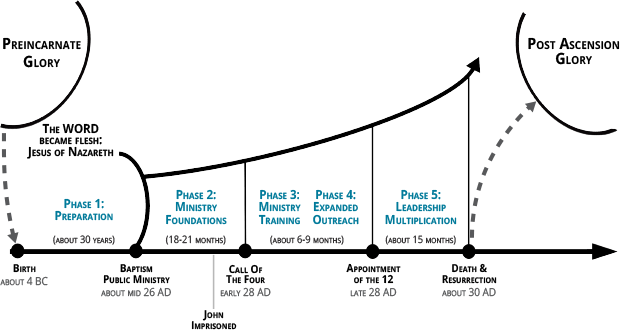
Beyond Phase 5: Multiplication of the movement itself
Write Movements of Multiplying Disciples Resulting in Churches.
April 30 AD – Pentecost
19 On the evening of that first day of the week, when the disciples were together, with the doors locked for fear of the Jewish leaders, Jesus came and stood among them and said, ‘Peace be with you!’20 After he said this, he showed them his hands and side. The disciples were overjoyed when they saw the Lord.
21 Again Jesus said, ‘Peace be with you! As the Father has sent me, I am sending you.’22 And with that he breathed on them and said, ‘Receive the Holy Spirit.23 If you forgive anyone’s sins, their sins are forgiven; if you do not forgive them, they are not forgiven.’
24 Now Thomas (also known as Didymus), one of the Twelve, was not with the disciples when Jesus came.25 So the other disciples told him, ‘We have seen the Lord!’
But he said to them, ‘Unless I see the nail marks in his hands and put my finger where the nails were, and put my hand into his side, I will not believe.’
12 Very truly I tell you, whoever believes in me will do the works I have been doing, and they will do even greater things than these, because I am going to the Father.
8 But you will receive power when the Holy Spirit comes on you; and you will be my witnesses in Jerusalem, and in all Judea and Samaria, and to the ends of the earth.’
5 Now there were staying in Jerusalem God-fearing Jews from every nation under heaven.
37 When the people heard this, they were cut to the heart and said to Peter and the other apostles, ‘Brothers, what shall we do?’
38 Peter replied, ‘Repent and be baptised, every one of you, in the name of Jesus Christ for the forgiveness of your sins. And you will receive the gift of the Holy Spirit.39 The promise is for you and your children and for all who are far off – for all whom the Lord our God will call.’
40 With many other words he warned them; and he pleaded with them, ‘Save yourselves from this corrupt generation.’41 Those who accepted his message were baptised, and about three thousand were added to their number that day.
42 They devoted themselves to the apostles’ teaching and to fellowship, to the breaking of bread and to prayer.43 Everyone was filled with awe at the many wonders and signs performed by the apostles.44 All the believers were together and had everything in common.45 They sold property and possessions to give to anyone who had need.46 Every day they continued to meet together in the temple courts. They broke bread in their homes and ate together with glad and sincere hearts,47 praising God and enjoying the favour of all the people. And the Lord added to their number daily those who were being saved.
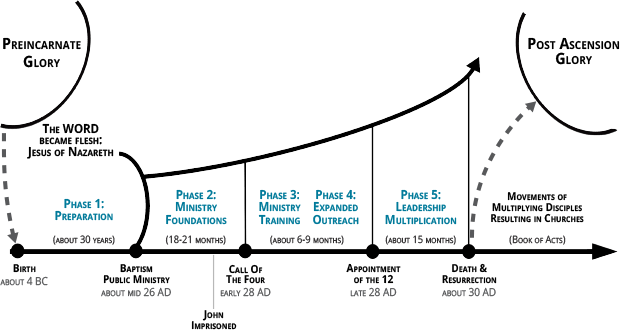
Have each group rearrange the 21 events from the life of Christ.
Ask them to look for details of chronology, sequence, progression and new developments over time.
After 5 minutes, review the correct order.
Have the groups discuss the following questions:
1) Preparation Phase
2) Ministry Foundations
3) Ministry Training
4) Expanded Outreach
5) Leadership Multiplication

Version 2.10

|

|